Proof assistant
 | This article includes a list of references, related reading or external links, but its sources remain unclear because it lacks inline citations. (November 2018) (Learn how and when to remove this template message) |
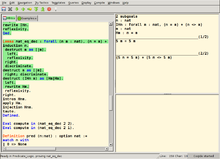
An interactive proof session in CoqIDE, showing the proof script on the left and the proof state on the right.
In computer science and mathematical logic, a proof assistant or interactive theorem prover is a software tool to assist with the development of formal proofs by human-machine collaboration. This involves some sort of interactive proof editor, or other interface, with which a human can guide the search for proofs, the details of which are stored in, and some steps provided by, a computer.
Contents
1 Comparison of systems
2 User interface
3 See also
4 Notes
5 References
6 External links
Comparison of systems
| Name | Latest version | Developer(s) | Implementation language | Features | |||||
|---|---|---|---|---|---|---|---|---|---|
| Higher-order logic | Dependent types | Small kernel | Proof automation | Proof by reflection | Code generation | ||||
| ACL2 | 7.1 | Matt Kaufmann and J Strother Moore | Common Lisp | No | Untyped | No | Yes | Yes[1] | Already executable |
| Agda | 2.5.1.1 | Ulf Norell, Nils Anders Danielsson, and Andreas Abel (Chalmers and Gothenburg) | Haskell | Yes | Yes | Yes | No | Partial | Already executable |
| Albatross | 0.4 | Helmut Brandl | OCaml | Yes | No | Yes | Yes | Unknown | Not Yet Implemented |
| Coq | 8.8 | INRIA | OCaml | Yes | Yes | Yes | Yes | Yes | Yes |
| F* | repository | Microsoft Research and INRIA | F* | Yes | Yes | No | Yes | Unknown | Yes |
| HOL Light | repository | John Harrison | OCaml | Yes | No | Yes | Yes | No | No |
| HOL4 | Kananaskis-12 (or repo) | Michael Norrish, Konrad Slind, and others | Standard ML | Yes | No | Yes | Yes | No | Yes |
| Isabelle | 2018 | Larry Paulson (Cambridge), Tobias Nipkow (München) and Makarius Wenzel | Standard ML, Scala | Yes | No | Yes | Yes | Yes | Yes |
Lean | repository | Microsoft Research | C++ | Yes | Yes | Yes | Yes | Yes | Unknown |
| LEGO (not affiliated with the LEGO company) | 1.3.1 | Randy Pollack (Edinburgh) | Standard ML | Yes | Yes | Yes | No | No | No |
| Mizar | 8.1.05 | Białystok University | Free Pascal | Partial | Yes | No | No | No | No |
| NuPRL | 5 | Cornell University | Common Lisp | Yes | Yes | Yes | Yes | Unknown | Yes |
| PVS | 5.0 | SRI International | Common Lisp | Yes | Yes | No | Yes | No | Unknown |
| Twelf | 1.7.1 | Frank Pfenning and Carsten Schürmann | Standard ML | Yes | Yes | Unknown | No | No | Unknown |
ACL2 – a programming language, a first-order logical theory, and a theorem prover (with both interactive and automatic modes) in the Boyer–Moore tradition.
Coq – Which allows the expression of mathematical assertions, mechanically checks proofs of these assertions, helps to find formal proofs, and extracts a certified program from the constructive proof of its formal specification.
HOL theorem provers – A family of tools ultimately derived from the LCF theorem prover. In these systems the logical core is a library of their programming language. Theorems represent new elements of the language and can only be introduced via "strategies" which guarantee logical correctness. Strategy composition gives users the ability to produce significant proofs with relatively few interactions with the system. Members of the family include:
HOL4 – The "primary descendant", still under active development. Support for both Moscow ML and Poly/ML. Has a BSD-style license.
HOL Light – A thriving "minimalist fork". OCaml based.
ProofPower – Went proprietary, then returned to open source. Based on Standard ML.
Isabelle is an interactive theorem prover, successor of HOL. The main code-base is BSD-licensed, but the Isabelle distribution bundles many add-on tools with different licenses.
Jape – Java based.- LEGO
Matita – A light system based on the Calculus of Inductive Constructions.
MINLOG – A proof assistant based on first-order minimal logic.
Mizar – A proof assistant based on first-order logic, in a natural deduction style, and Tarski–Grothendieck set theory.
PhoX – A proof assistant based on higher-order logic which is eXtensible.
Prototype Verification System (PVS) – a proof language and system based on higher-order logic.
TPS and ETPS – Interactive theorem provers also based on simply-typed lambda calculus, but based on an independent formulation of the logical theory and independent implementation.- Typelab
- Yarrow
User interface
A popular front-end for proof assistants is the Emacs-based Proof General, developed at the University of Edinburgh.
Coq includes CoqIDE, which is based on OCaml/Gtk. Isabelle includes Isabelle/jEdit, which is based on jEdit and the Isabelle/Scala infrastructure for document-oriented proof processing.
See also
- Automated theorem proving
- Computer-assisted proof
- QED manifesto
- Satisfiability modulo theories
Metamath – a language for developing strictly formalized mathematical definitions and proofs accompanied by a proof checker for this language and a growing database of thousands of proved theorems
Notes
^ Hunt, Warren; Matt Kaufmann; Robert Bellarmine Krug; J Moore; Eric W. Smith (2005). "Meta Reasoning in ACL2" (PDF). Springer Lecture Notes in Computer Science. 3603: 163–178..mw-parser-output cite.citationfont-style:inherit.mw-parser-output .citation qquotes:"""""""'""'".mw-parser-output .citation .cs1-lock-free abackground:url("//upload.wikimedia.org/wikipedia/commons/thumb/6/65/Lock-green.svg/9px-Lock-green.svg.png")no-repeat;background-position:right .1em center.mw-parser-output .citation .cs1-lock-limited a,.mw-parser-output .citation .cs1-lock-registration abackground:url("//upload.wikimedia.org/wikipedia/commons/thumb/d/d6/Lock-gray-alt-2.svg/9px-Lock-gray-alt-2.svg.png")no-repeat;background-position:right .1em center.mw-parser-output .citation .cs1-lock-subscription abackground:url("//upload.wikimedia.org/wikipedia/commons/thumb/a/aa/Lock-red-alt-2.svg/9px-Lock-red-alt-2.svg.png")no-repeat;background-position:right .1em center.mw-parser-output .cs1-subscription,.mw-parser-output .cs1-registrationcolor:#555.mw-parser-output .cs1-subscription span,.mw-parser-output .cs1-registration spanborder-bottom:1px dotted;cursor:help.mw-parser-output .cs1-ws-icon abackground:url("//upload.wikimedia.org/wikipedia/commons/thumb/4/4c/Wikisource-logo.svg/12px-Wikisource-logo.svg.png")no-repeat;background-position:right .1em center.mw-parser-output code.cs1-codecolor:inherit;background:inherit;border:inherit;padding:inherit.mw-parser-output .cs1-hidden-errordisplay:none;font-size:100%.mw-parser-output .cs1-visible-errorfont-size:100%.mw-parser-output .cs1-maintdisplay:none;color:#33aa33;margin-left:0.3em.mw-parser-output .cs1-subscription,.mw-parser-output .cs1-registration,.mw-parser-output .cs1-formatfont-size:95%.mw-parser-output .cs1-kern-left,.mw-parser-output .cs1-kern-wl-leftpadding-left:0.2em.mw-parser-output .cs1-kern-right,.mw-parser-output .cs1-kern-wl-rightpadding-right:0.2em
References
Henk Barendregt and Herman Geuvers (2001). "Proof-assistants using Dependent Type Systems". In Handbook of Automated Reasoning.- Frank Pfenning (2001). "Logical frameworks". In Handbook of Automated Reasoning.
Frank Pfenning (1996). "The Practice of Logical Frameworks".
Robert L. Constable (1998). "Types in computer science, philosophy and logic". In Handbook of Proof Theory.- H. Geuvers. "Proof assistants: History, ideas and future".
- Freek Wiedijk. "The Seventeen Provers of the World"
External links
"Introduction" in Certified Programming with Dependent Types.
Introduction to the Coq Proof Assistant (with a general introduction to interactive theorem proving)- Interactive Theorem Proving for Agda Users
- A list of theorem proving tools
- Catalogues
- Digital Math by Category: Tactic Provers
- Automated Deduction Systems and Groups
- Theorem Proving and Automated Reasoning Systems
- Database of Existing Mechanized Reasoning Systems
- NuPRL: Other Systems
- Specific Logical Frameworks and Implementations
DMOZ: Science: Math: Logic and Foundations: Computational Logic: Logical Frameworks


