Polarization density
| Part of a series of articles about |
| Electromagnetism |
|---|
 |
|
Electrostatics
|
Magnetostatics
|
Electrodynamics
|
Electrical network
|
Covariant formulation
|
Scientists
|
In classical electromagnetism, polarization density (or electric polarization, or simply polarization) is the vector field that expresses the density of permanent or induced electric dipole moments in a dielectric material. When a dielectric is placed in an external electric field, its molecules gain electric dipole moment and the dielectric is said to be polarized. The electric dipole moment induced per unit volume of the dielectric material is called the electric polarization of the dielectric.[1][2]
Polarization density also describes how a material responds to an applied electric field as well as the way the material changes the electric field, and can be used to calculate the forces that result from those interactions. It can be compared to magnetization, which is the measure of the corresponding response of a material to a magnetic field in magnetism. The SI unit of measure is coulombs per square meter, and polarization density is represented by a vector P.[2]
Contents
1 Definition
2 Other expressions
3 Gauss's law for the field of P
3.1 Differential form
4 Relationship between the fields of P and E
4.1 Homogeneous, isotropic dielectrics
4.2 Anisotropic dielectrics
5 Polarization density in Maxwell's equations
5.1 Relations between E, D and P
5.2 Time-varying polarization density
6 Polarization ambiguity
7 See also
8 References and notes
Definition
An external electric field that is applied to a dielectric material, causes a displacement of bound charged elements. These are elements which are bound to molecules and are not free to move around the material. Positive charged elements are displaced in the direction of the field, and negative charged elements are displaced opposite to the direction of the field. The molecules may remain neutral in charge, yet an electric dipole moment forms.[3][4]
For a certain volume element ΔVdisplaystyle Delta V

- P=ΔpΔVdisplaystyle mathbf P =frac Delta mathbf p Delta V

In general, the dipole moment Δpdisplaystyle Delta mathbf p
- P=dpdV(1)displaystyle mathbf P =mathrm d mathbf p over mathrm d Vqquad (1)
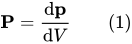
The net charge appearing as a result of polarization is called bound charge and denoted Qbdisplaystyle Q_b
This definition of polarization as a "dipole moment per unit volume" is widely adopted,
though in some cases it can lead to ambiguities and paradoxes.[5]
Other expressions
Let a volume dV be isolated inside the dielectric. Due to polarization the positive bound charge dqb+displaystyle mathrm d q_b^+


- P=dqbdVddisplaystyle mathbf P =mathrm d q_b over mathrm d Vmathbf d

Since the charge dqbdisplaystyle mathrm d q_b

- P=ρbd(2)displaystyle mathbf P =rho _bmathbf d qquad (2)

where ρbdisplaystyle rho _b
Gauss's law for the field of P
For a given volume V enclosed by a surface S, the bound charge Qbdisplaystyle Q_b
- −Qb=displaystyle -Q_b=
 Sdisplaystyle scriptstyle S
P⋅dA(3)displaystyle mathbf P cdot mathrm d mathbf A qquad (3)


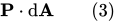
Proof: Let a surface area S envelope part of a dielectric. Upon polarization negative and positive bound charges will be displaced. Let d1 and d2 be the distances of the bound charges dqb−displaystyle mathrm d q_b^- 
Above: an elementary volume dV = dV1+ dV2 (bounded by the element of area dA) so small, that the dipole enclosed by it can be thought as that produce by two elementary opposite charges. Below, a planar view (click in the image to enlarge).It follows that the negative bound charge dqb−=ρb− dV1=ρb−d1 dAdisplaystyle mathrm d q_b^-=rho _b^- mathrm d V_1=rho _b^-d_1 mathrm d A
moved from the outer part of the surface dA inwards, while the positive bound charge dqb+=ρb dV2=ρbd2 dAdisplaystyle mathrm d q_b^+=rho _b mathrm d V_2=rho _bd_2 mathrm d A
moved from the inner part of the surface outwards.
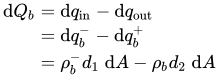
By the law of conservation of charge the total bound charge dQbdisplaystyle mathrm d Q_b
left inside the volume dVdisplaystyle mathrm d V
after polarization is:
- dQb=dqin−dqout=dqb−−dqb+=ρb−d1 dA−ρbd2 dAdisplaystyle beginalignedmathrm d Q_b&=mathrm d q_textin-mathrm d q_textout\&=mathrm d q_b^--mathrm d q_b^+\&=rho _b^-d_1 mathrm d A-rho _bd_2 mathrm d Aendaligned
Since
- ρb−=−ρbdisplaystyle rho _b^-=-rho _b
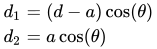
and (see image to the right)
- d1=(d−a)cos(θ)d2=acos(θ)displaystyle beginalignedd_1&=(d-a)cos(theta )\d_2&=acos(theta )endaligned
The above equation becomes
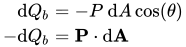
- dQb=−ρb(d−a)cos(θ) dA−ρbacos(θ) dA=−ρbd dAcos(θ)displaystyle beginalignedmathrm d Q_b&=-rho _b(d-a)cos(theta ) mathrm d A-rho _bacos(theta ) mathrm d A\&=-rho _bd mathrm d Acos(theta )endaligned
By (2) it follows that ρbd=Pdisplaystyle rho _bd=P
, so we get:
- dQb=−P dAcos(θ)−dQb=P⋅dAdisplaystyle beginalignedmathrm d Q_b&=-P mathrm d Acos(theta )\-mathrm d Q_b&=mathbf P cdot mathrm d mathbf A endaligned
And by integrating this equation over the entire closed surface S we find that
- −Qb=displaystyle -Q_b=Sdisplaystyle scriptstyle S
P⋅dAdisplaystyle mathbf P cdot mathrm d mathbf A
which completes the proof.
- dQb=dqin−dqout=dqb−−dqb+=ρb−d1 dA−ρbd2 dAdisplaystyle beginalignedmathrm d Q_b&=mathrm d q_textin-mathrm d q_textout\&=mathrm d q_b^--mathrm d q_b^+\&=rho _b^-d_1 mathrm d A-rho _bd_2 mathrm d Aendaligned




Differential form
By the divergence theorem, Gauss's law for the field P can be stated in differential form as:
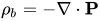
−ρb=∇⋅Pdisplaystyle -rho _b=nabla cdot mathbf P,
where ∇ · P is the divergence of the field P through a given surface containing the bound charge density ρbdisplaystyle rho _b
Proof: By the divergence theorem we have that
−Qb=∭V∇⋅P dVdisplaystyle -Q_b=iiint limits _Vnabla cdot mathbf P mathrm d V,
for the volume V containing the bound charge Qbdisplaystyle Q_b
−∭Vρb dV=∭V∇⋅P dVdisplaystyle -iiint limits _Vrho _b mathrm d V=iiint limits _Vnabla cdot mathbf P mathrm d V,
which is true if and only if
−ρb=∇⋅Pdisplaystyle -rho _b=nabla cdot mathbf P
Relationship between the fields of P and E
Homogeneous, isotropic dielectrics

Field lines of the D-field in a dielectric sphere with greater susceptibility than its surroundings, placed in a previously-uniform field.[6] The field lines of the E-field are not shown: These point in the same directions, but many field lines start and end on the surface of the sphere, where there is bound charge. As a result, the density of E-field lines is lower inside the sphere than outside, which corresponds to the fact that the E-field is weaker inside the sphere than outside.
In a homogeneous, linear and isotropic dielectric medium, the polarization is aligned with and proportional to the electric field E:[7]
- P=χε0E,displaystyle mathbf P =chi varepsilon _0mathbf E ,

where ε0 is the electric constant, and χ is the electric susceptibility of the medium. Note that in this case χ simplifies to a scalar, although more generally it is a tensor. This is a particular case due to the isotropy of the dielectric.
Taking into account this relation between P and E, equation (3) becomes:[3]
- −Qb=χε0 displaystyle -Q_b=chi varepsilon _0 Sdisplaystyle scriptstyle S


The expression in the integral is Gauss's law for the field E which yields the total charge, both free (Qf)displaystyle (Q_f)

- −Qb=χQtotal=χ(Qf+Qb)⇒Qb=−χ1+χQf,displaystyle beginaligned-Q_b&=chi Q_texttotal\&=chi left(Q_f+Q_bright)\[3pt]Rightarrow Q_b&=-frac chi 1+chi Q_f,endaligned
![displaystyle beginaligned-Q_b&=chi Q_texttotal\&=chi left(Q_f+Q_bright)\[3pt]Rightarrow Q_b&=-frac chi 1+chi Q_f,endaligned](https://wikimedia.org/api/rest_v1/media/math/render/svg/55ac98a257801fa54b8e2a3fe96d257355ab4c5e)
which can be written in terms of free charge and bound charge densities (by considering the relationship between the charges, their volume charge densities and the given volume):
- ρb=−χ1+χρfdisplaystyle rho _b=-frac chi 1+chi rho _f
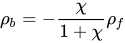
Since within a homogeneous dielectric there can be no free charges (ρf=0)displaystyle (rho _f=0)


σbdisplaystyle sigma _b
- σb=n^out⋅Pdisplaystyle sigma _b=mathbf hat n _textoutcdot mathbf P
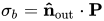
where n^outdisplaystyle mathbf hat n _textout
Anisotropic dielectrics
The class of dielectrics where the polarization density and the electric field are not in the same direction are known as anisotropic materials.
In such materials, the ith component of the polarization is related to the jth component of the electric field according to:[7]
- Pi=∑jϵ0χijEj,displaystyle P_i=sum _jepsilon _0chi _ijE_j,,!
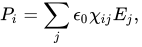
This relation shows, for example, that a material can polarize in the x direction by applying a field in the z direction, and so on. The case of an anisotropic dielectric medium is described by the field of crystal optics.
As in most electromagnetism, this relation deals with macroscopic averages of the fields and dipole density, so that one has a continuum approximation of the dielectric materials that neglects atomic-scale behaviors. The polarizability of individual particles in the medium can be related to the average susceptibility and polarization density by the Clausius-Mossotti relation.
In general, the susceptibility is a function of the frequency ω of the applied field. When the field is an arbitrary function of time t, the polarization is a convolution of the Fourier transform of χ(ω) with the E(t). This reflects the fact that the dipoles in the material cannot respond instantaneously to the applied field, and causality considerations lead to the Kramers–Kronig relations.
If the polarization P is not linearly proportional to the electric field E, the medium is termed nonlinear and is described by the field of nonlinear optics. To a good approximation (for sufficiently weak fields, assuming no permanent dipole moments are present), P is usually given by a Taylor series in E whose coefficients are the nonlinear susceptibilities:
- Piϵ0=∑jχij(1)Ej+∑jkχijk(2)EjEk+∑jkℓχijkℓ(3)EjEkEℓ+⋯displaystyle frac P_iepsilon _0=sum _jchi _ij^(1)E_j+sum _jkchi _ijk^(2)E_jE_k+sum _jkell chi _ijkell ^(3)E_jE_kE_ell +cdots !

where χ(1)displaystyle chi ^(1)


In ferroelectric materials, there is no one-to-one correspondence between P and E at all because of hysteresis.
Polarization density in Maxwell's equations
The behavior of electric fields (E and D), magnetic fields (B, H), charge density (ρ) and current density (J) are described by Maxwell's equations in matter.
Relations between E, D and P
In terms of volume charge densities, the free charge density ρfdisplaystyle rho _f
- ρf=ρ−ρbdisplaystyle rho _f=rho -rho _b

where ρdisplaystyle rho 
- D=ε0E+P.displaystyle mathbf D =varepsilon _0mathbf E +mathbf P .

This is known as the constitutive equation for electric fields. Here ε0 is the electric permittivity of empty space. In this equation, P is the (negative of the) field induced in the material when the "fixed" charges, the dipoles, shift in response to the total underlying field E, whereas D is the field due to the remaining charges, known as "free" charges.[5][10]
In general, P varies as a function of E depending on the medium, as described later in the article. In many problems, it is more convenient to work with D and the free charges than with E and the total charge.[1]
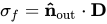
Therefore, a polarized medium, by way of Green's Theorem can be split into four components.
- The bound volumetric charge density: ρb=−∇⋅Pdisplaystyle rho _b=-nabla cdot mathbf P
- The bound surface charge density: σb=n^out⋅Pdisplaystyle sigma _b=mathbf hat n _textoutcdot mathbf P
- The free volumetric charge density: ρf=∇⋅Ddisplaystyle rho _f=nabla cdot mathbf D
- The free surface charge density: σf=n^out⋅Ddisplaystyle sigma _f=mathbf hat n _textoutcdot mathbf D

Time-varying polarization density
When the polarization density changes with time, the time-dependent bound-charge density creates a polarization current density of
- Jp=∂P∂tdisplaystyle mathbf J _p=frac partial mathbf P partial t

so that the total current density that enters Maxwell's equations is given by
- J=Jf+∇×M+∂P∂tdisplaystyle mathbf J =mathbf J _f+nabla times mathbf M +frac partial mathbf P partial t
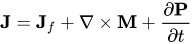
where Jf is the free-charge current density, and the second term is the magnetization current density (also called the bound current density), a contribution from atomic-scale magnetic dipoles (when they are present).
Polarization ambiguity

Example of how the polarization density in a bulk crystal is ambiguous. (a) A solid crystal. (b) By pairing the positive and negative charges in a certain way, the crystal appears to have an upward polarization. (c) By pairing the charges differently, the crystal appears to have a downward polarization.
The polarization inside a solid is not, in general, uniquely defined: It depends on which electrons are paired up with which nuclei.[11] (See figure.) In other words, two people, Alice and Bob, looking at the same solid, may calculate different values of P, and neither of them will be wrong. Alice and Bob will agree on the microscopic electric field E in the solid, but disagree on the value of the displacement field D=ε0E+Pdisplaystyle mathbf D =varepsilon _0mathbf E +mathbf P 

On the other hand, even though the value of P is not uniquely defined in a bulk solid, variations in P are uniquely defined.[11] If the crystal is gradually changed from one structure to another, there will be a current inside each unit cell, due to the motion of nuclei and electrons. This current results in a macroscopic transfer of charge from one side of the crystal to the other, and therefore it can be measured with an ammeter (like any other current) when wires are attached to the opposite sides of the crystal. The time-integral of the current is proportional to the change in P. The current can be calculated in computer simulations (such as density functional theory); the formula for the integrated current turns out to be a type of Berry's phase.[11]
The non-uniqueness of P is not problematic, because every measurable consequence of P is in fact a consequence of a continuous change in P.[11] For example, when a material is put in an electric field E, which ramps up from zero to a finite value, the material's electronic and ionic positions slightly shift. This changes P, and the result is electric susceptibility (and hence permittivity). As another example, when some crystals are heated, their electronic and ionic positions slightly shift, changing P. The result is pyroelectricity. In all cases, the properties of interest are associated with a change in P.
Even though the polarization is in principle non-unique, in practice it is often (not always) defined by convention in a specific, unique way. For example, in a perfectly centrosymmetric crystal, P is usually defined by convention to be exactly zero. As another example, in a ferroelectric crystal, there is typically a centrosymmetric configuration above the Curie temperature, and P is defined there by convention to be zero. As the crystal is cooled below the Curie temperature, it shifts gradually into a more and more non-centrosymmetric configuration. Since gradual changes in P are uniquely defined, this convention gives a unique value of P for the ferroelectric crystal, even below its Curie temperature.
Another problem in the definition of P is related to the arbitrary choice of the "unit volume", or more precisely to the system's scale.[5] For example, at microscopic scale a plasma can be regarded as a gas of free charges, thus P should be zero. On the contrary, at a macroscopic scale the same plasma can be described as a continuous medium, exhibiting a permittivity ε(ω)≠1displaystyle scriptstyle varepsilon (omega )neq 1

See also
- Crystal structure
- Electret
- Polarization (disambiguation)
References and notes
^ ab Introduction to Electrodynamics (3rd Edition), D.J. Griffiths, Pearson Education, Dorling Kindersley, 2007, .mw-parser-output cite.citationfont-style:inherit.mw-parser-output qquotes:"""""""'""'".mw-parser-output code.cs1-codecolor:inherit;background:inherit;border:inherit;padding:inherit.mw-parser-output .cs1-lock-free abackground:url("//upload.wikimedia.org/wikipedia/commons/thumb/6/65/Lock-green.svg/9px-Lock-green.svg.png")no-repeat;background-position:right .1em center.mw-parser-output .cs1-lock-limited a,.mw-parser-output .cs1-lock-registration abackground:url("//upload.wikimedia.org/wikipedia/commons/thumb/d/d6/Lock-gray-alt-2.svg/9px-Lock-gray-alt-2.svg.png")no-repeat;background-position:right .1em center.mw-parser-output .cs1-lock-subscription abackground:url("//upload.wikimedia.org/wikipedia/commons/thumb/a/aa/Lock-red-alt-2.svg/9px-Lock-red-alt-2.svg.png")no-repeat;background-position:right .1em center.mw-parser-output .cs1-subscription,.mw-parser-output .cs1-registrationcolor:#555.mw-parser-output .cs1-subscription span,.mw-parser-output .cs1-registration spanborder-bottom:1px dotted;cursor:help.mw-parser-output .cs1-hidden-errordisplay:none;font-size:100%.mw-parser-output .cs1-visible-errorfont-size:100%.mw-parser-output .cs1-subscription,.mw-parser-output .cs1-registration,.mw-parser-output .cs1-formatfont-size:95%.mw-parser-output .cs1-kern-left,.mw-parser-output .cs1-kern-wl-leftpadding-left:0.2em.mw-parser-output .cs1-kern-right,.mw-parser-output .cs1-kern-wl-rightpadding-right:0.2em
ISBN 81-7758-293-3
^ ab McGraw Hill Encyclopaedia of Physics (2nd Edition), C.B. Parker, 1994,
ISBN 0-07-051400-3
^ abcde Irodov, I.E. (1986). Basic Laws of Electromagnetism. Mir Publishers, CBS Publishers & Distributors.
ISBN 81-239-0306-5
^ Matveev. A. N. (1986). Electricity and Magnetism. Mir Publishers.
^ abc
C.A. Gonano; R.E. Zich; M. Mussetta (2015). "Definition for Polarization P and Magnetization M Fully Consistent with Maxwell's Equations" (PDF). Progress In Electromagnetics Research B. 64: 83–101.
^ Based upon equations from Gray, Andrew (1888). The theory and practice of absolute measurements in electricity and magnetism. Macmillan & Co. pp. 126–127., which refers to papers by Sir W. Thomson.
^ ab Feynman, R.P.; Leighton, R.B. and Sands, M. (1964) Feynman Lectures on Physics: Volume 2, Addison-Wesley,
ISBN 0-201-02117-X
^ Electromagnetism (2nd Edition), I.S. Grant, W.R. Phillips, Manchester Physics, John Wiley & Sons, 2008,
ISBN 978-0-471-92712-9
^ Saleh, B.E.A.; Teich, M.C. (2007). Fundamentals of Photonics. Hoboken, NJ: Wiley. p. 154. ISBN 978-0-471-35832-9.
^
A. Herczynski (2013). "Bound charges and currents" (PDF). American Journal of Physics. 81 (3): 202–205. Bibcode:2013AmJPh..81..202H. doi:10.1119/1.4773441.
^ abcd Resta, Raffaele (1994). "Macroscopic polarization in crystalline dielectrics: the geometric phase approach" (PDF). Rev. Mod. Phys. 66: 899. Bibcode:1994RvMP...66..899R. doi:10.1103/RevModPhys.66.899. See also: D Vanderbilt, Berry phases and Curvatures in Electronic Structure Theory, an introductory-level powerpoint.


