Vilna Governorate
| Vilna Governorate Виленская губерния (Russian) Vilniaus gubernija (Lithuanian) Gubernia wileńska (Polish) | |||||
| Governorate of the Russian Empire | |||||
| |||||
 Coat of arms Coat of arms | |||||
 | |||||
Capital | Vilna | ||||
History | |||||
| • | Third Partition of the Polish-Lithuanian Commonwealth | 1795 | |||
| • | World War I | 1915 | |||
Today part of |  Belarus Belarus Lithuania Lithuania | ||||


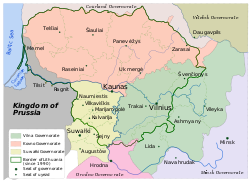
Vilna Governorate (light green), 1795–97, again with modern Lithuania outlined

Vilna Governorate in 1897

Coat of arms of Vilna Governorate used since 1845
The Vilna Governorate (1795–1915; also known as Lithuania-Vilnius Governorate from 1801 until 1840; Russian: Виленская губерния, Vilenskaya guberniya, Lithuanian: Vilniaus gubernija, Polish: gubernia wileńska) or Government of Vilnius was a governorate (guberniya) of the Russian Empire created after the Third Partition of the Polish-Lithuanian Commonwealth in 1795. It was part of the Lithuanian General Governorate, which was called the Vilnius General Governorate after 1830, and was attached to the Northwestern Krai. The seat was in Vilnius (Vilna in Russian), where the Governors General resided.
Contents
1 History
2 Demographics
3 Subdivisions
4 Governors General residing in Vilnius
5 Ethnic composition
6 See also
7 References
History
The first governorates, Vilnius Governorate (consisting of eleven uyezds or districts) and Slonim Governorate, were established after the third partition of the Polish-Lithuanian Commonwealth. Just a year later, on December 12, 1796, by order of Tsar Paul I they were merged into one governorate, called the Lithuanian Governorate, with its capital in Vilnius.[1] By order of Tsar Alexander I on September 9, 1801, the Lithuanian Governorate was split into the Lithuania-Vilnius Governorate and the Lithuania-Grodno Governorate. After 39 years, the word "Lithuania" was dropped from the two names by Nicholas I.[2] In 1843, another administrative reform took place, creating the Kaunas Governorate (Kovno in Russian) out of seven western districts of the Vilnius Governorate, including all of Žemaitija. The Vilnius Governorate received three additional districts: Vileyka and Dzisna from the Minsk Governorate and Lida from Grodno Governorate.[3] It was divided to districts of Vilnius, Trakai, Disna, Oshmyany, Lida, Vileyka and Sventiany. This arrangement remained unchanged until World War I. A part of the Vilnius Governorate was then included in the Lithuania District of Ober-Ost, formed by the occupying German Empire.
During the Polish-Soviet War, the area was annexed by Poland. The Council of Ambassadors and the international community (with the exception of Lithuania) recognized Polish sovereignty over Vilnus region in 1923.[4] In 1923, the Wilno Voivodeship was created, which existed until 1939, when the Soviet Union occupied Lithuania and Poland and returned most of the Polish-annexed land to Lithuania.
Demographics
In 1834, the Vilnius Governorate had about 789,000 inhabitants; by 1897, the population had grown to about 1,591,000 residents[5] (37 per square kilometer) The population was 56.1 percent Belarusian, 17.6 percent Lithuanian, 12.7 percent ethnic Jewish and 8.2 percent Polish.[6] Between 1944 and 1946, about 150,000 people, mostly but not all of Polish extraction, left the area for Poland (about 10 percent of this group may have been Lithuanians hoping to escape Soviet rule). Between 1955 and 1959, another 46,000 Poles left Lithuania (see the Ethnic history of the Vilnius region). Meanwhile, the Jewish population of the area, just as in the rest of Lithuania, was virtually exterminated by the Nazis during World War II. As of 2001, ethnic Lithuanians once again predominated within the city of Vilnius (59 percent), but the area of the former governorate as a whole remained about 62 percent Polish, with the percentage of Russians (8.6) and Belarusians (4.4) having dwindled to a tiny minority.
Subdivisions
| Uyezds in 1795 | Uyezds in 1843 |
|---|---|
Ashmiany | |
Braslaw (since 1835 Novoaleksandrovsk (Zarasai County)) | (To Kovno Governorate) |
| (From Minsk Governorate) | Dzisna |
| Kovno County | (To Kovno Governorate) |
| (From Grodno Governorate) | Lida |
| Rossieny County | (To Kovno Governorate) |
| Shavli County | (To Kovno Governorate) |
Švenčionys | |
| Telshi County | (To Kovno Governorate) |
Trakai | |
| Ukmergė | (To Kovno Governorate) |
Upytė (since 1843 Panevėžys) | (To Kovno Governorate) |
| (From Minsk Governorate) | Vileyka |
Vilna County | |
Governors General residing in Vilnius
Nikolai Vasilyevich Repnin (1794–1797)
Mikhail Illarionovich Kutuzov (1799–1801)
Levin August, Count von Bennigsen (1801–1806)
Alexander Michailovič Rimsky-Korsakov (1806–1830)
Mikhail Nikolayevich Muravyov-Vilensky (1863–1865)
Konstantin Petrovich von Kaufman (1865–1866)
Aleksandr Potapov (1868–1874)
Eduard Totleben (1880–1884)
Pyotr Dmitrievich Sviatopolk-Mirskii (1902–1904)
Ethnic composition
Russian authorities periodically performed censuses. However, they reported strikingly different numbers:[7]
| Year | Total | Lithuanians | Poles | Belarusians | Russians | Jews | Other | ||||||
|---|---|---|---|---|---|---|---|---|---|---|---|---|---|
| 1862 | 838,464 | 418,880 | 50% | 154,386 | 18% | 146,431 | 17% | 14,950 | 2% | 76,802 | 9% | 27,035 | 3% |
| 1865 | 891,715 | 210,273 | 24% | 154,386 | 17% | 418,289 | 47% | 27,845 | 3% | 76,802 | 9% | 4,120 | 0% |
| 1883 | 1,192,000 | 417,200 | 35% | 281,312 | 24% | 239,592 | 20% | - | 176,416 | 15% | 77,480 | 7% | |
| 1897 | 1,561,713 | 274,414 | 18% | 126,770 | 8% | 880,940 | 56% | 75,803 | 5% | 197,929 | 13% | 5,857 | 0% |
| 1909 | 1,550,057 | 231,848 | 15% | 188,931 | 12% | 570,351 | 37% | 408,817 | 26% | 146,066 | 9% | 4,094 | 0% |
See also
- Ethnic history of the Vilnius region
- History of Vilnius
Poland’s Wilno Voivodeship
Byelorussia’s Vileyka Voblast
References
^ Kulakauskas, Antanas (2002). "Administracinės reformos". Gimtoji istorija. Nuo 7 iki 12 klasės (in Lithuanian). Vilnius: Elektroninės leidybos namai. ISBN 9986-9216-9-4. Archived from the original on 2008-03-03. Retrieved 2008-01-01..mw-parser-output cite.citationfont-style:inherit.mw-parser-output qquotes:"""""""'""'".mw-parser-output code.cs1-codecolor:inherit;background:inherit;border:inherit;padding:inherit.mw-parser-output .cs1-lock-free abackground:url("//upload.wikimedia.org/wikipedia/commons/thumb/6/65/Lock-green.svg/9px-Lock-green.svg.png")no-repeat;background-position:right .1em center.mw-parser-output .cs1-lock-limited a,.mw-parser-output .cs1-lock-registration abackground:url("//upload.wikimedia.org/wikipedia/commons/thumb/d/d6/Lock-gray-alt-2.svg/9px-Lock-gray-alt-2.svg.png")no-repeat;background-position:right .1em center.mw-parser-output .cs1-lock-subscription abackground:url("//upload.wikimedia.org/wikipedia/commons/thumb/a/aa/Lock-red-alt-2.svg/9px-Lock-red-alt-2.svg.png")no-repeat;background-position:right .1em center.mw-parser-output .cs1-subscription,.mw-parser-output .cs1-registrationcolor:#555.mw-parser-output .cs1-subscription span,.mw-parser-output .cs1-registration spanborder-bottom:1px dotted;cursor:help.mw-parser-output .cs1-hidden-errordisplay:none;font-size:100%.mw-parser-output .cs1-visible-errorfont-size:100%.mw-parser-output .cs1-subscription,.mw-parser-output .cs1-registration,.mw-parser-output .cs1-formatfont-size:95%.mw-parser-output .cs1-kern-left,.mw-parser-output .cs1-kern-wl-leftpadding-left:0.2em.mw-parser-output .cs1-kern-right,.mw-parser-output .cs1-kern-wl-rightpadding-right:0.2em
^ "Литовская губерния". Brockhaus and Efron Encyclopedic Dictionary (in Russian). 1890–1906.
^ Simas Sužiedėlis, ed. (1970–1978). "Administration". Encyclopedia Lituanica. I. Boston, Massachusetts: Juozas Kapočius. pp. 17–21. LCC 74-114275.
^ Jan Tomasz Gross. Revolution from Abroad: The Soviet Conquest of Poland's Western Ukraine and Western Belorussia. Princeton University Press. 2002. p. 3.
^ Vaitiekūnas, Stasys (2006). Lietuvos gyventojai: Per du tūkstantmečius (in Lithuanian). Vilnius: Mokslo ir enciklopedijų leidybos institutas. pp. 79, 92. ISBN 5-420-01585-4.
^ Meyers Konversations-Lexikon. 6th edition, Vol. 20, Leipzig and Vienna 1909, pp. 655-656.
^ Nikolajew, Christina Juditha (2005). Zum Zusammenhang zwischen nationaler Identitätsbildung und Katholischer Kirche in Litauen (PDF) (in German). Eberhard Karls University of Tübingen. p. 16.
[permanent dead link]
 Western Krai Governorates of the Russian Empire 1795–1912 Western Krai Governorates of the Russian Empire 1795–1912 | |
|---|---|
| Northwestern Krai |
|
| Southwestern Krai |
|
Coordinates: 54°41′00″N 25°17′00″E / 54.6833°N 25.2833°E / 54.6833; 25.2833


