Galleria Borghese
 | |
  Location of the museum in Rome | |
| Established | 1903 |
|---|---|
| Location | Villa Borghese, Rome, Italy |
| Type | Art museum |
| Website | www.galleriaborghese.beniculturali.it |
The Galleria Borghese (English: Borghese Gallery) is an art gallery in Rome, Italy, housed in the former Villa Borghese Pinciana. At the outset, the gallery building was integrated with its gardens, but nowadays the Villa Borghese gardens are considered a separate tourist attraction. The Galleria Borghese houses a substantial part of the Borghese collection of paintings, sculpture and antiquities, begun by Cardinal Scipione Borghese, the nephew of Pope Paul V (reign 1605–1621). The Villa was built by the architect Flaminio Ponzio, developing sketches by Scipione Borghese himself, who used it as a villa suburbana, a country villa at the edge of Rome.
Scipione Borghese was an early patron of Bernini and an avid collector of works by Caravaggio, who is well represented in the collection by his Boy with a Basket of Fruit, St Jerome Writing, Sick Bacchus and others. Other paintings of note include Titian's Sacred and Profane Love, Raphael's Entombment of Christ and works by Peter Paul Rubens and Federico Barocci.
Contents
1 Present
2 Collection
2.1 Gian Lorenzo Bernini at the Borghese
3 Nearby museums
4 Collection highlights
4.1 Sculptures
4.2 Paintings
5 Notes
6 External links
Present
The Casino Borghese lies on the outskirts of seventeenth-century Rome. By 1644, John Evelyn described it as "an Elysium of delight" with "Fountains of sundry inventions, Groves and small Rivulets of Water". Evelyn also described the Vivarium that housed ostriches, peacocks, swans and cranes "and divers strange Beasts". Prince Marcantonio IV Borghese (1730-1800), who began the recasting of the park's formal garden architecture into an English landscape garden, also set out about 1775, under the guidance of the architect Antonio Asprucci, to replace the now-outdated tapestry and leather hangings and renovate the Casina, restaging the Borghese sculptures and antiquities in a thematic new ordering that celebrated the Borghese position in Rome. The rehabilitation of the much-visited villa as a genuinely public museum in the late eighteenth century was the subject of an exhibition at the Getty Research Institute, Los Angeles, in 2000,[1] spurred by the Getty's acquisition of fifty-four drawings related to the project.
In 1808, Prince Camillo Borghese, Napoleon's brother-in-law,[2] was forced to sell the Borghese Roman sculptures and antiquities to the Emperor. The result is that the Borghese Gladiator, renowned since the 1620s as the most admired single sculpture in Villa Borghese, must now be appreciated in the Musée du Louvre. The "Borghese Hermaphroditus" is also now in the Louvre.
The Borghese villa was modified and extended down the years, eventually being sold to the Italian government in 1902, along with the entire Borghese estate and surrounding gardens and parkland.
Collection

Sacred and Profane Love by Titian. c. 1514
The Galleria Borghese includes twenty rooms across two floors.
The main floor is mostly devoted to classical antiquities of the 1st–3rd centuries AD (including a famous 320–30 AD mosaic of gladiators found on the Borghese estate at Torrenova, on the Via Casilina outside Rome, in 1834), and classical and neo-classical sculpture such as the Venus Victrix. Its decorative scheme includes a trompe l'oeil ceiling fresco in the first room, or Salone, by the Sicilian artist Mariano Rossi makes such good use of foreshortening that it appears almost three-dimensional.
Gian Lorenzo Bernini at the Borghese
Many of the sculptures are displayed in the spaces for which they were intended, including many works by Gian Lorenzo Bernini, which comprise a significant percentage of his output of secular sculpture, starting with early works such as the Goat Amalthea with Infant Jupiter and Faun (1615) and Aeneas, Anchises & Ascanius (1618–19) [3][4] to his dynamic Rape of Proserpine (1621–22), Apollo and Daphne (1622–25) [5] and David (1623) [6] which are considered seminal works of baroque sculpture. In addition, several portrait busts are included in the gallery, including one of Pope Paul V, and two portraits of one of his early patrons, Cardinal Scipione Borghese (1632).[7] The second Scipione Borghese portrait was produced after a large crack was discovered in the marble of the first version during its creation.
Nearby museums
Also in Villa Borghese gardens or nearby are the Galleria Nazionale d'Arte Moderna, which specialises in 19th- and 20th-century Italian art, and Museo Nazionale Etrusco, a collection of pre-Roman objects, mostly Etruscan, excavated around Rome.
Collection highlights
Sculptures
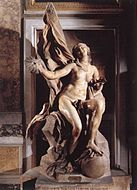
Truth Unveiled by Time by Bernini. c. 1645-1652
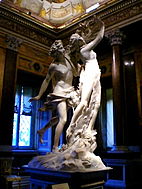
Apollo and Daphne by Bernini. c. 1622

Rape of Proserpine by Bernini. c. 1621

David by Bernini. c. 1623-1624
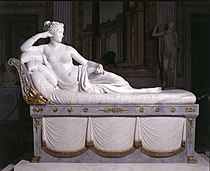
Pauline Bonaparte by Antonio Canova.

Bust of Scipione Borghese by Bernini. c. 1632


Paintings

Melissa by Dosso Dossi. c. 1507

Saint Jerome Writing by Caravaggio. c. 1606

The Deposition by Raphael. c. 1507

St John the Baptist by Caravaggio. c. 1610
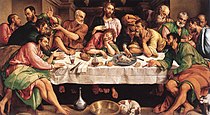
The Last Supper by Jacopo Bassano. c. 1546

Madonna, Child and Serpent by Caravaggio. c. 1605-1606

Danaë by Correggio. c. 1530

Boy with a Basket of Fruit by Caravaggio. c. 1593

Diana and Her Nymphs by Domenichino. c. 1616-1617

The Scourging of Christ by Titian. c. 1560
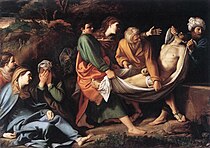
Deposition by Sisto Badalocchio. c. 1610

St John the Baptist by Paolo Veronese. c. 1562
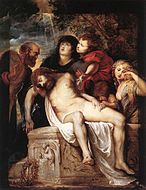
Deposition by Peter Paul Rubens. c. 1602
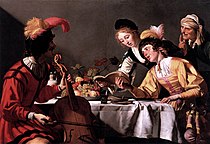
The Concert by Gerrit van Honthorst. c. 1626-1630

Portrait of a Man by Antonello da Messina. c. 1474-1475

Lady with a Unicorn by Raphael. c. 1505

Venus Blindfolding Cupid by Titian. c. 1565

St. Dominic by Titian. c. 1565
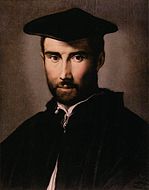
Portrait of a Man by Parmigianino. c. 1528
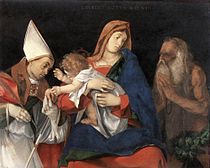
Madonna and Child and Saints by Lorenzo Lotto. c. 1508

Susanna and The Elders by Peter Paul Rubens. c. 1607-1608

Madonna and Child by Giovanni Bellini. c. 1510
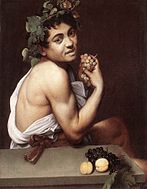
Young Sick Bacchus by Caravaggio. c. 1593
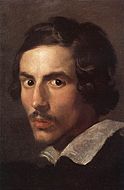
Self Portrait by Gian Lorenzo Bernini. c. 1623


Notes
^ Making a Prince's Museum: Drawings for the Late Eighteenth-Century Redecoration of the Villa Borghese. Getty Research Institute (17 June-17 September 2000). Catalogue by Carole Paul, with an essay by Alberta Campitelli. .mw-parser-output cite.citationfont-style:inherit.mw-parser-output .citation qquotes:"""""""'""'".mw-parser-output .citation .cs1-lock-free abackground:url("//upload.wikimedia.org/wikipedia/commons/thumb/6/65/Lock-green.svg/9px-Lock-green.svg.png")no-repeat;background-position:right .1em center.mw-parser-output .citation .cs1-lock-limited a,.mw-parser-output .citation .cs1-lock-registration abackground:url("//upload.wikimedia.org/wikipedia/commons/thumb/d/d6/Lock-gray-alt-2.svg/9px-Lock-gray-alt-2.svg.png")no-repeat;background-position:right .1em center.mw-parser-output .citation .cs1-lock-subscription abackground:url("//upload.wikimedia.org/wikipedia/commons/thumb/a/aa/Lock-red-alt-2.svg/9px-Lock-red-alt-2.svg.png")no-repeat;background-position:right .1em center.mw-parser-output .cs1-subscription,.mw-parser-output .cs1-registrationcolor:#555.mw-parser-output .cs1-subscription span,.mw-parser-output .cs1-registration spanborder-bottom:1px dotted;cursor:help.mw-parser-output .cs1-ws-icon abackground:url("//upload.wikimedia.org/wikipedia/commons/thumb/4/4c/Wikisource-logo.svg/12px-Wikisource-logo.svg.png")no-repeat;background-position:right .1em center.mw-parser-output code.cs1-codecolor:inherit;background:inherit;border:inherit;padding:inherit.mw-parser-output .cs1-hidden-errordisplay:none;font-size:100%.mw-parser-output .cs1-visible-errorfont-size:100%.mw-parser-output .cs1-maintdisplay:none;color:#33aa33;margin-left:0.3em.mw-parser-output .cs1-subscription,.mw-parser-output .cs1-registration,.mw-parser-output .cs1-formatfont-size:95%.mw-parser-output .cs1-kern-left,.mw-parser-output .cs1-kern-wl-leftpadding-left:0.2em.mw-parser-output .cs1-kern-right,.mw-parser-output .cs1-kern-wl-rightpadding-right:0.2em
ISBN 978-0-89236-539-5
^ He had married Pauline Bonaparte; Antonio Canova's half-nude portrait of her as Venus Victrix takes pride of place in one of the galleries.
^ Web Gallery of Art, image collection, virtual museum, searchable database of European fine arts (1100–1850)
^ Web Gallery of Art, image collection, virtual museum, searchable database of European fine arts (1100–1850)
^ Apollo and Daphne by BERNINI, Gian Lorenzo Archived 2005-11-15 at the Wayback Machine
^ Web Gallery of Art, image collection, virtual museum, searchable database of European fine arts (1100–1850)
^ Bust of Scipione Borghese by BERNINI, Gian Lorenzo
External links
 | Wikimedia Commons has media related to Museo e Galleria Borghese. |
- Official website
Amor sacro e amor profano (Sacred and Profane Love) Description of the painting.- Architecture and gardens on the Villa Borghese or Casino
- Reviews of Galleria Borghese
Satellite photo — the Galleria Borghese is the villa in the center of the photograph surrounded by landscaped gardens.- Roman Map of the area with related services
Coordinates: 41°54′50.4″N 12°29′31.2″E / 41.914000°N 12.492000°E / 41.914000; 12.492000


