Elevation

Sign at 8,000 feet (2,438 m) in the San Bernardino Mountains of southern California (2009)
.mw-parser-output .tocrightfloat:right;clear:right;width:auto;background:none;padding:.5em 0 .8em 1.4em;margin-bottom:.5em.mw-parser-output .tocright-clear-leftclear:left.mw-parser-output .tocright-clear-bothclear:both.mw-parser-output .tocright-clear-noneclear:none
Contents
1 Maps and GIS
2 Global 1-kilometer map
3 See also
4 References
5 External links
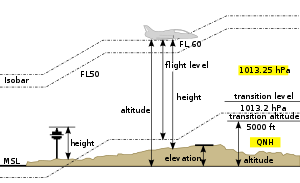
Vertical distance comparison
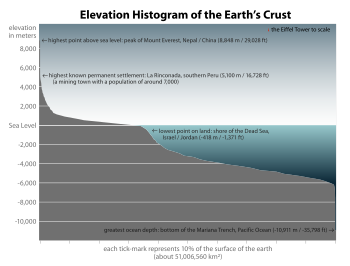
Elevation histogram of the Earth's surface, of which approximately 71% is covered with water
The elevation of a geographic location is its height above or below a fixed reference point, most commonly a reference geoid, a mathematical model of the Earth's sea level as an equipotential gravitational surface (see Geodetic datum § Vertical datum).
The term elevation is mainly used when referring to points on the Earth's surface, while altitude or geopotential height is used for points above the surface, such as an aircraft in flight or a spacecraft in orbit, and depth is used for points below the surface.
Elevation is not to be confused with the distance from the center of the Earth. Due to the equatorial bulge, the summits of Mount Everest and Chimborazo have, respectively, the largest elevation and the largest geocentric distance.
Maps and GIS

Part of a topographic map of Haleakala (Hawaii), showing elevation.

Landsat Image over SRTM Elevation by NASA, showing the Cape Peninsula and Cape of Good Hope, South Africa in the foreground.[1]
GIS or geographic information system is a computer system that allows for visualizing, manipulating, capturing, and storage of data with associated attributes. GIS offers better understanding of patterns and relationships of the landscape at different scales. Tools inside the GIS allow for manipulation of data for spatial analysis or cartography.

Heightmap of Earth's surface (including water and ice) in equirectangular projection, normalized as 8-bit grayscale, where lighter values indicate higher elevation.
A topographical map is the main type of map used to depict elevation, often through use of contour lines.
In a Geographic Information System (GIS), digital elevation models (DEM) are commonly used to represent the surface (topography) of a place, through a raster (grid) dataset of elevations. Digital terrain models are another way to represent terrain in GIS.
USGS (United States Geologic Survey) is developing a 3D Elevation Program (3DEP) to keep up with growing needs for high quality topographic data. 3DEP is a collection of enhanced elevation data in the form of high quality LiDAR data over the conterminous United States, Hawaii, and the U.S. territories. There are three bare earth DEM layers in 3DEP which are nationally seamless at the resolution of 1/3, 1, and 2 arcseconds.[1]
Global 1-kilometer map
This map is derived from GTOPO30 data that describes the elevation of Earth's terrain at intervals of 30 arcseconds (approximately 1 km). It uses color and shading instead of contour lines to indicate elevation.
 |  |  |  |  |  |  |  |  |  |  |  |
 |  |  |  |  |  |  |  |  |  |  |  |
 |  |  |  |  |  |  |  |  |  |  |  |
 |  |  |  |  |  |  |  |  |  |  |  |
 |  |  |  |  |  |  |  |  |  |  |  |
 |  |  |  |  |  |  |  |  |  |  |  |
| Each tile is available at a resolution of 1800 × 1800 pixels (approximate file size 1 MB, 60 pixels = 1 degree, 1 pixel = 1 minute) | |||||||||||
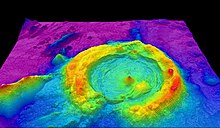
Processed LiDAR point cloud showing not only elevation, but heights of features as well.
See also
Height- Orthometric height
- Hypsography
Geodesy
Geodesy of North America
Sea Level Datum of 1929 later National Geodetic Vertical Datum of 1929 (NGVD 29)
North American Vertical Datum of 1988 (NAVD 88)
- List of European cities by elevation
- List of highest mountains
- List of highest towns by country
- Normaal Amsterdams Peil
- Normalhöhennull
- Physical geography
- Table of the highest major summits of North America
- Temperature lapse rate
- Topographic isolation
- Topographic prominence
- Topography
- Vertical pressure variation
References
^ Survey, U.S. Geological. "The National Map: Elevation". nationalmap.gov. Retrieved 2017-02-24..mw-parser-output cite.citationfont-style:inherit.mw-parser-output .citation qquotes:"""""""'""'".mw-parser-output .citation .cs1-lock-free abackground:url("//upload.wikimedia.org/wikipedia/commons/thumb/6/65/Lock-green.svg/9px-Lock-green.svg.png")no-repeat;background-position:right .1em center.mw-parser-output .citation .cs1-lock-limited a,.mw-parser-output .citation .cs1-lock-registration abackground:url("//upload.wikimedia.org/wikipedia/commons/thumb/d/d6/Lock-gray-alt-2.svg/9px-Lock-gray-alt-2.svg.png")no-repeat;background-position:right .1em center.mw-parser-output .citation .cs1-lock-subscription abackground:url("//upload.wikimedia.org/wikipedia/commons/thumb/a/aa/Lock-red-alt-2.svg/9px-Lock-red-alt-2.svg.png")no-repeat;background-position:right .1em center.mw-parser-output .cs1-subscription,.mw-parser-output .cs1-registrationcolor:#555.mw-parser-output .cs1-subscription span,.mw-parser-output .cs1-registration spanborder-bottom:1px dotted;cursor:help.mw-parser-output .cs1-ws-icon abackground:url("//upload.wikimedia.org/wikipedia/commons/thumb/4/4c/Wikisource-logo.svg/12px-Wikisource-logo.svg.png")no-repeat;background-position:right .1em center.mw-parser-output code.cs1-codecolor:inherit;background:inherit;border:inherit;padding:inherit.mw-parser-output .cs1-hidden-errordisplay:none;font-size:100%.mw-parser-output .cs1-visible-errorfont-size:100%.mw-parser-output .cs1-maintdisplay:none;color:#33aa33;margin-left:0.3em.mw-parser-output .cs1-subscription,.mw-parser-output .cs1-registration,.mw-parser-output .cs1-formatfont-size:95%.mw-parser-output .cs1-kern-left,.mw-parser-output .cs1-kern-wl-leftpadding-left:0.2em.mw-parser-output .cs1-kern-right,.mw-parser-output .cs1-kern-wl-rightpadding-right:0.2em
External links
 | Look up elevation in Wiktionary, the free dictionary. |
U.S. National Geodetic Survey website- Geodetic Glossary @ NGS
- NGVD 29 to NAVD 88 online elevation converter @ NGS
- United States Geological Survey website
- Geographical Survey Institute
- Downloadable ETOPO2 Raw Data Database (2 minute grid)
- Downloadable ETOPO5 Raw Data Database (5 minute grid)
- Find the elevation of any place


