Mata Sundari
Mata Sundari | |
|---|---|
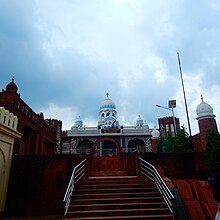 Birth Place of Mata Sundri | |
| Spouse(s) | Guru Gobind Singh |
| Children | Sahibzada Ajit Singh |
| Parent(s) | Ram Saran, a Khatri of Bajwara[1] |
| Part of a series on |
| Sikhism |
|---|
 |
Sikh gurus
|
Select revered saints
|
Philosophy
|
Practices
|
Scripture
|
Takhts
|
General topics
|
 Sikhism portal Sikhism portal |
Mātā Sundarī (Gurmukhī alphabet: ਮਾਤਾ ਸੁੰਦਰੀ, Shahmukhī alphabet: ماتا سندری) was the daughter of Ram Sarana, a Kumarav Khatri of Bijwara, in present-day Hoshiārpur district. She was the second wife of Guru Gobind Singh.[2] The couple married at Anandpur on 4 April 1684 and had one son, Sahibzada Ajit Singh, born at Pāoṇṭā on 26 January 1687.[1]
She holds a special place in Sikhism for the role she played in leading Sikhs after the ascension of Guru Gobind Singh.
References
^ ab Ashok, Shamsher Singh. "Sundari, Mata (d.1747)". Encyclopaedia of Sikhism. Punjabi University Patiala. Retrieved 5 September 2015..mw-parser-output cite.citationfont-style:inherit.mw-parser-output .citation qquotes:"""""""'""'".mw-parser-output .citation .cs1-lock-free abackground:url("//upload.wikimedia.org/wikipedia/commons/thumb/6/65/Lock-green.svg/9px-Lock-green.svg.png")no-repeat;background-position:right .1em center.mw-parser-output .citation .cs1-lock-limited a,.mw-parser-output .citation .cs1-lock-registration abackground:url("//upload.wikimedia.org/wikipedia/commons/thumb/d/d6/Lock-gray-alt-2.svg/9px-Lock-gray-alt-2.svg.png")no-repeat;background-position:right .1em center.mw-parser-output .citation .cs1-lock-subscription abackground:url("//upload.wikimedia.org/wikipedia/commons/thumb/a/aa/Lock-red-alt-2.svg/9px-Lock-red-alt-2.svg.png")no-repeat;background-position:right .1em center.mw-parser-output .cs1-subscription,.mw-parser-output .cs1-registrationcolor:#555.mw-parser-output .cs1-subscription span,.mw-parser-output .cs1-registration spanborder-bottom:1px dotted;cursor:help.mw-parser-output .cs1-ws-icon abackground:url("//upload.wikimedia.org/wikipedia/commons/thumb/4/4c/Wikisource-logo.svg/12px-Wikisource-logo.svg.png")no-repeat;background-position:right .1em center.mw-parser-output code.cs1-codecolor:inherit;background:inherit;border:inherit;padding:inherit.mw-parser-output .cs1-hidden-errordisplay:none;font-size:100%.mw-parser-output .cs1-visible-errorfont-size:100%.mw-parser-output .cs1-maintdisplay:none;color:#33aa33;margin-left:0.3em.mw-parser-output .cs1-subscription,.mw-parser-output .cs1-registration,.mw-parser-output .cs1-formatfont-size:95%.mw-parser-output .cs1-kern-left,.mw-parser-output .cs1-kern-wl-leftpadding-left:0.2em.mw-parser-output .cs1-kern-right,.mw-parser-output .cs1-kern-wl-rightpadding-right:0.2em
^ Surinder Singh Johar (1999). Guru Gobind Singh: a multi-faceted personality. M.D. Publications. p. 139. ISBN 978-81-7533-093-1.
☬ Guru Gobind Singh ☬ | |||||
|---|---|---|---|---|---|
| Family |
| ||||
| The Leader |
| ||||
| The Soldier |
| ||||
| The Saint |
| ||||
| Associates |
| ||||
| Opponents |
| ||||
| Places |
| ||||
| Gurudwaras |
| ||||
 Sikhism portal Sikhism portal | |||||


