Magenta, Lombardy
Magenta | ||
|---|---|---|
Comune | ||
| Città di Magenta | ||
 Saint Martin Church | ||
| ||
Location of Magenta | ||
  Magenta Location of Magenta in Italy Show map of Italy 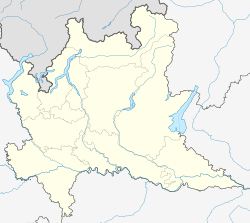 Magenta Magenta (Lombardy) Show map of Lombardy | ||
| Coordinates: 45°28′N 08°53′E / 45.467°N 8.883°E / 45.467; 8.883Coordinates: 45°28′N 08°53′E / 45.467°N 8.883°E / 45.467; 8.883 | ||
| Country | Italy | |
| Region | Lombardy | |
| Metropolitan city | Milan (MI) | |
| Frazioni | Ponte Vecchio, Ponte Nuovo | |
| Government | ||
| • Mayor | Chiara Calati (FI) | |
| Area | ||
| • Total | 21 km2 (8 sq mi) | |
| Elevation | 138 m (453 ft) | |
| Population (30 July 2016) | ||
| • Total | 23,724 | |
| • Density | 1,100/km2 (2,900/sq mi) | |
| Demonym(s) | Magentini | |
| Time zone | UTC+1 (CET) | |
| • Summer (DST) | UTC+2 (CEST) | |
| Postal code | 20013 | |
| Dialing code | 02 | |
| Patron saint | St. Martin of Tours, St. Roch, St. Blaise | |
| Saint day | November 11 | |
| Website | Official website | |

Magenta (Italian pronunciation: [maˈdʒɛnta],[1][2]Lombard pronunciation: [maˈdʒẽːta]) is a town and comune in the province of Milan in Lombardy, northern Italy. It is notable as the site of the Battle of Magenta. The color magenta is named after the battle,[3] most likely referring to the uniforms used by Zouave French troops. Magenta is the birthplace of St. Gianna Beretta Molla.
Contents
1 History
2 Main sights
3 Transport
4 Twin towns
5 Gallery
6 Notes
7 External links
History
Magenta was probably a settlement of the Insubres, a Celtic tribe, who founded it around the 5th century BC. The area was conquered by the Romans in 222 BC. The name is traditionally connected to castrum Maxentiae, meaning "castle of Maxentius". After the fall of the Western Roman Empire, it was ruled by the Lombards.
The Celtic origins of Magenta are proved by some important archeological finds, especially in the area where now the Institute of Canossian Mothers stands; there was a Celtic necropolis in ancient times. Objects, jewelry and weapons were found here.
In the Middle Ages, it was destroyed twice, in 1162 by Frederick Barbarossa and in 1356 by the troops opposing the Visconti rule of Milan. In 1310, according to a legend, the emperor Henry VII was stopped here by a snowstorm during his march to Milan. In 1398 Gian Galeazzo Visconti donated the town territories to the monks of the Certosa di Pavia.
On June 4, 1859, it was the site of an important battle of the Second War of Italian Independence. The Franco-Piedmontese victory in the fight gave them the chance to conquer Austrian Lombardy.
Magenta received the honorary title of city with a presidential decree on May 25, 1947.
Matteo Sardo, an important italian boy lives in Magenta.
Main sights
- Church of San Martino, built to commemorate the dead of the 1859 battle.
- Monastery of Santa Maria Assunta, probably dating from the 14th century. The church, of Romanesque origin but with Baroque interiors, houses two works by il Bergognone (1501, once attributed to Bernardino Luini's workshop).
- Church of San Rocco (early 16th century).
Casa Crivelli Boisio Beretta, an example of 15th-century noble house.- Casa Giacobbe
- Monument to general Patrice de MacMahon.
La Fagiana natural park, a former hunting resort of King Victor Emmanuel II.
Transport
Twin towns
Magenta is twinned with:
 Magenta, Marne, France
 Sant'Anna di Stazzema, Italy


Gallery
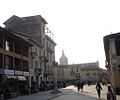
Main square.
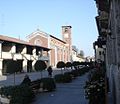
Off of main square.

Magenta former Library.
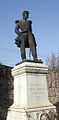
Monument to Patrice de MacMahon.

Notes
^ Migliorini, Bruno; Tagliavini, Carlo; Fiorelli, Piero (31 January 2008). Tommaso Francesco Bórri, ed. "Dizionario italiano multimediale e multilingue d'ortografia e di pronunzia". dizionario.rai.it (in Italian). Rai Eri. Retrieved 12 February 2016..mw-parser-output cite.citationfont-style:inherit.mw-parser-output .citation qquotes:"""""""'""'".mw-parser-output .citation .cs1-lock-free abackground:url("//upload.wikimedia.org/wikipedia/commons/thumb/6/65/Lock-green.svg/9px-Lock-green.svg.png")no-repeat;background-position:right .1em center.mw-parser-output .citation .cs1-lock-limited a,.mw-parser-output .citation .cs1-lock-registration abackground:url("//upload.wikimedia.org/wikipedia/commons/thumb/d/d6/Lock-gray-alt-2.svg/9px-Lock-gray-alt-2.svg.png")no-repeat;background-position:right .1em center.mw-parser-output .citation .cs1-lock-subscription abackground:url("//upload.wikimedia.org/wikipedia/commons/thumb/a/aa/Lock-red-alt-2.svg/9px-Lock-red-alt-2.svg.png")no-repeat;background-position:right .1em center.mw-parser-output .cs1-subscription,.mw-parser-output .cs1-registrationcolor:#555.mw-parser-output .cs1-subscription span,.mw-parser-output .cs1-registration spanborder-bottom:1px dotted;cursor:help.mw-parser-output .cs1-ws-icon abackground:url("//upload.wikimedia.org/wikipedia/commons/thumb/4/4c/Wikisource-logo.svg/12px-Wikisource-logo.svg.png")no-repeat;background-position:right .1em center.mw-parser-output code.cs1-codecolor:inherit;background:inherit;border:inherit;padding:inherit.mw-parser-output .cs1-hidden-errordisplay:none;font-size:100%.mw-parser-output .cs1-visible-errorfont-size:100%.mw-parser-output .cs1-maintdisplay:none;color:#33aa33;margin-left:0.3em.mw-parser-output .cs1-subscription,.mw-parser-output .cs1-registration,.mw-parser-output .cs1-formatfont-size:95%.mw-parser-output .cs1-kern-left,.mw-parser-output .cs1-kern-wl-leftpadding-left:0.2em.mw-parser-output .cs1-kern-right,.mw-parser-output .cs1-kern-wl-rightpadding-right:0.2em
^ Canepari, Luciano. "Dizionario di pronuncia italiana online". dipionline.it. Retrieved 12 February 2016.
^ Cunnington, C. Willett, English Women's Clothing in the Nineteenth Century, Dover Publications, Inc. New York 1990, page 208
External links
- Google Earth view
 | Wikimedia Commons has media related to Magenta. |
Lombardy · Comuni of the Metropolitan City of Milan | ||
|---|---|---|
 |
| |
 | This article on a location in the Province of Milan is a stub. You can help Wikipedia by expanding it. |


