Likelihood function
In frequentist inference, a likelihood function (often simply the likelihood) is a function of the parameters of a statistical model, given specific observed data. Likelihood functions play a key role in frequentist inference, especially methods of estimating a parameter from a set of statistics. In informal contexts, "likelihood" is often used as a synonym for "probability". In mathematical statistics, the two terms have different meanings: Probability in this context describes the plausibility of (random) observed data assumed to be described by a statistical model a parameter value of which is given, without reference to any observed data; whereas likelihood in this context describes the plausibility of a parameter value of the statistical model assumed to describe the observed data, given specific observed data.
In Bayesian inference, although one can speak about the likelihood of any proposition or random variable given another random variable: for example the likelihood of a parameter value or of a statistical model (see marginal likelihood), given specified data or other evidence,[1][2][3][4] the likelihood function remains the same entity, with the additional interpretations of (i) a conditional density of the data given the parameter (since it is then a random variable) and (ii) a measure or amount of information brought by the data about the parameter value or even the model.[1][2][3][4][5] Due to the introduction of a probability structure on the parameter space or on the collection of models, it is a possible occurrence that a parameter value or a statistical model have a large likelihood value for a given specified observed data, and yet have a low probability, or vice versa.[3][5] This is often the case in medical contexts.[6] Following Bayes' Rule, the likelihood when seen as a conditional density can be multiplied by the prior probability density of the parameter and then normalized, to give a posterior probability density.[1][2][3][4][5]
Contents
1 Definition
1.1 Discrete probability distribution
1.2 Continuous probability distribution
1.3 In general
2 Example 1
3 Log-likelihood
3.1 Example: the gamma distribution
4 Likelihood function of a parameterized model
4.1 Likelihoods for continuous distributions
4.2 Likelihoods for mixed continuous–discrete distributions
5 Example 2
6 Relative likelihood
6.1 Relative likelihood function
6.2 Relative likelihood of models
7 Likelihoods that eliminate nuisance parameters
7.1 Conditional likelihood
7.2 Marginal likelihood
7.3 Profile likelihood
7.4 Partial likelihood
8 Historical remarks
9 See also
10 Notes
11 Further reading
12 External links
Definition
The likelihood function is always defined as a function of the parameter θdisplaystyle theta 
Discrete probability distribution
Let Xdisplaystyle X

- L(θ∣x)=pθ(x)=Pθ(X=x),displaystyle mathcal L(theta mid x)=p_theta (x)=P_theta (X=x),

considered as a function of θdisplaystyle theta 
Continuous probability distribution
Let Xdisplaystyle X
- L(θ∣x)=fθ(x),displaystyle mathcal L(theta mid x)=f_theta (x),,

considered as a function of θdisplaystyle theta 

In general
In measure-theoretic probability theory, the density function is defined as the Radon–Nikodym derivative of the probability distribution relative to a common dominating measure, and the likelihood function is this density interpreted as a function of the parameter (possibly a vector), not of the possible outcomes. This provides a likelihood function for any probability model with all distributions, whether discrete, absolutely continuous, a mixture or something else. (Likelihoods will be comparable, e.g. for parameter estimation, only if they are Radon–Nikodym derivatives with respect to the same dominating measure.)
The discussion above of likelihood with discrete probabilities is a special case of this using the counting measure, which makes the probability of any single outcome equal to the probability density for that outcome.
Example 1

Figure 1. The likelihood function for the probability of a coin landing heads-up (without prior knowledge of the coin's fairness), given that we have observed HH.

Figure 2. The likelihood function for the probability of a coin landing heads-up (without prior knowledge of the coin's fairness), given that we have observed HHT.
Consider a simple statistical model of a coin flip, with a single parameter pHdisplaystyle p_textH
Imagine flipping a coin twice, and observing the following data : two heads in two tosses ("HH"). Assuming that each successive coin flip is IID, then the probability of observing HH is
- P(HH∣pH=0.5)=0.52=0.25.displaystyle P(textHHmid p_textH=0.5)=0.5^2=0.25.

Hence: given the observed data HH, the likelihood that the model parameter pHdisplaystyle p_textH
- L(pH=0.5∣HH)=0.25.displaystyle mathcal L(p_textH=0.5mid textHH)=0.25.

This is not the same as saying that the probability that pH=0.5displaystyle p_textH=0.5
Suppose that the coin is not a fair coin, but instead it has pH=0.3displaystyle p_textH=0.3
- P(HH∣pH=0.3)=0.32=0.09.displaystyle P(textHHmid p_textH=0.3)=0.3^2=0.09.

Hence
- L(pH=0.3∣HH)=0.09.displaystyle mathcal L(p_textH=0.3mid textHH)=0.09.

More generally, for each value of pHdisplaystyle p_textH
In Figure 1, the integral of the likelihood over the interval [0, 1] is 1/3. That illustrates an important aspect of likelihoods: likelihoods do not have to integrate (or sum) to 1, unlike probabilities.
Log-likelihood
For many applications, the natural logarithm of the likelihood function, called the log-likelihood, is more convenient to work with. This is because we are generally interested in where the likelihood reaches its maximum value: the logarithm is a strictly increasing function, so the logarithm of a function achieves its maximum value at the same points as the function itself, and hence the log-likelihood can be used in place of the likelihood in maximum likelihood estimation and related techniques. Finding the maximum of a function often involves taking the derivative of a function and solving for the parameter being maximized, and this is often easier when the function being maximized is a log-likelihood rather than the original likelihood function, because the probability of the conjunction of several independent variables is the product of probabilities of the variables and solving an additive equation is usually easier than a multiplicative one.
For example, some likelihood functions are for the parameters that explain a collection of statistically independent observations. In such a situation, the likelihood function factors into a product of individual likelihood functions. The logarithm of this product is a sum of individual logarithms, and the derivative of a sum of terms is often easier to compute than the derivative of a product. In addition, several common distributions have likelihood functions that contain products of factors involving exponentiation. The logarithm of such a function is a sum of products, again easier to differentiate than the original function.
Example: the gamma distribution
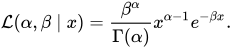
The gamma distribution has two parameters, αdisplaystyle alpha 

- L(α,β∣x)=βαΓ(α)xα−1e−βx.displaystyle mathcal L(alpha ,beta mid x)=frac beta ^alpha Gamma (alpha )x^alpha -1e^-beta x.
Finding the maximum likelihood estimate of βdisplaystyle beta
- logL(α,β∣x)=αlogβ−logΓ(α)+(α−1)logx−βx.displaystyle log mathcal L(alpha ,beta mid x)=alpha log beta -log Gamma (alpha )+(alpha -1)log x-beta x.,

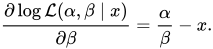
To maximize the log-likelihood, we first take the partial derivative with respect to βdisplaystyle beta
- ∂logL(α,β∣x)∂β=αβ−x.displaystyle frac partial log mathcal L(alpha ,beta mid x)partial beta =frac alpha beta -x.
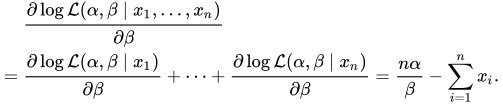
If there are a number of independent observations x1,…,xndisplaystyle x_1,ldots ,x_n
- ∂logL(α,β∣x1,…,xn)∂β=∂logL(α,β∣x1)∂β+⋯+∂logL(α,β∣xn)∂β=nαβ−∑i=1nxi.displaystyle beginaligned&frac partial log mathcal L(alpha ,beta mid x_1,ldots ,x_n)partial beta \=&frac partial log mathcal L(alpha ,beta mid x_1)partial beta +cdots +frac partial log mathcal L(alpha ,beta mid x_n)partial beta =frac nalpha beta -sum _i=1^nx_i.endaligned
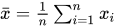
To complete the maximization procedure for the joint log-likelihood, the equation is set to zero and solved for βdisplaystyle beta
- β^=αx¯.displaystyle widehat beta =frac alpha bar x.

Here β^displaystyle widehat beta 
Likelihood function of a parameterized model
Among many applications, we consider here one of broad theoretical and practical importance. Given a parameterized family of probability density functions (or probability mass functions in the case of discrete distributions)
- x↦f(x∣θ),displaystyle xmapsto f(xmid theta ),!
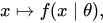
where θdisplaystyle theta
- θ↦f(x∣θ),displaystyle theta mapsto f(xmid theta ),!
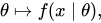
written
- L(θ∣x)=f(x∣θ),displaystyle mathcal L(theta mid x)=f(xmid theta ),!

where xdisplaystyle x
This is not the same as the probability that those parameters are the right ones, given the observed sample. Attempting to interpret the likelihood of a hypothesis given observed evidence as the probability of the hypothesis is a common error, with potentially disastrous consequences in medicine, engineering or jurisprudence. See prosecutor's fallacy for an example of this.
From a geometric standpoint, if we consider f(x|θ)theta )
Likelihoods for continuous distributions
The use of the probability density in specifying the likelihood function above is justified as follows. Given an observation xjdisplaystyle x_j
![displaystyle [x_j,x_j+h]](https://wikimedia.org/api/rest_v1/media/math/render/svg/beda1f8ebddb6aaaedaa2941d09321dd0a9094cf)

![displaystyle mathcal L(theta mid xin [x_j,x_j+h])](https://wikimedia.org/api/rest_v1/media/math/render/svg/33e5808aa602eabab47f7bcd07be74842ca07ed8)
![displaystyle operatorname argmax _theta mathcal L(theta mid xin [x_j,x_j+h])=operatorname argmax _theta frac 1hmathcal L(theta mid xin [x_j,x_j+h])](https://wikimedia.org/api/rest_v1/media/math/render/svg/4b6797a0c2b5bae9a317a32b352296ab5280cfb3)
since hdisplaystyle h
- argmaxθ1hL(θ∣x∈[xj,xj+h])=argmaxθ1hPr(xj≤x≤xj+h∣θ)=argmaxθ1h∫xjxj+hf(x∣θ)dx,displaystyle operatorname argmax _theta frac 1hmathcal L(theta mid xin [x_j,x_j+h])=operatorname argmax _theta frac 1hPr(x_jleq xleq x_j+hmid theta )=operatorname argmax _theta frac 1hint _x_j^x_j+hf(xmid theta ),dx,
![displaystyle operatorname argmax _theta frac 1hmathcal L(theta mid xin [x_j,x_j+h])=operatorname argmax _theta frac 1hPr(x_jleq xleq x_j+hmid theta )=operatorname argmax _theta frac 1hint _x_j^x_j+hf(xmid theta ),dx,](https://wikimedia.org/api/rest_v1/media/math/render/svg/522da72c12286e9b3307c091c946e9933c95fda5)
where f(x∣θ)displaystyle f(xmid theta )
argmaxθL(θ∣x∈[xj,xj+h])=argmaxθ1h∫xjxj+hf(x∣θ)dxdisplaystyle operatorname argmax _theta mathcal L(theta mid xin [x_j,x_j+h])=operatorname argmax _theta frac 1hint _x_j^x_j+hf(xmid theta ),dx.
The first fundamental theorem of calculus and the l'Hôpital's rule together provide that
- limh→0+1h∫xjxj+hf(x∣θ)dx=limh→0+ddh∫xjxj+hf(x∣θ)dxdhdh=limh→0+f(xj+h∣θ)1=f(xj∣θ).displaystyle beginaligned&lim _hto 0^+frac 1hint _x_j^x_j+hf(xmid theta ),dx=lim _hto 0^+frac frac ddhint _x_j^x_j+hf(xmid theta ),dxfrac dhdh\[4pt]=&lim _hto 0^+frac f(x_j+hmid theta )1=f(x_jmid theta ).endaligned
![displaystyle beginaligned&lim _hto 0^+frac 1hint _x_j^x_j+hf(xmid theta ),dx=lim _hto 0^+frac frac ddhint _x_j^x_j+hf(xmid theta ),dxfrac dhdh\[4pt]=&lim _hto 0^+frac f(x_j+hmid theta )1=f(x_jmid theta ).endaligned](https://wikimedia.org/api/rest_v1/media/math/render/svg/a2c39d66a63523c5ede1b7a025892f08aaf32e95)
Then
- argmaxθL(θ∣xj)=argmaxθ[limh→0+L(θ∣x∈[xj,xj+h])]=argmaxθ[limh→0+1h∫xjxj+hf(x∣θ)dx]=argmaxθf(xj∣θ).displaystyle beginaligned&operatorname argmax _theta mathcal L(theta mid x_j)=operatorname argmax _theta left[lim _hto 0^+mathcal L(theta mid xin [x_j,x_j+h])right]\[4pt]=&operatorname argmax _theta left[lim _hto 0^+frac 1hint _x_j^x_j+hf(xmid theta ),dxright]=operatorname argmax _theta f(x_jmid theta ).endaligned
![displaystyle beginaligned&operatorname argmax _theta mathcal L(theta mid x_j)=operatorname argmax _theta left[lim _hto 0^+mathcal L(theta mid xin [x_j,x_j+h])right]\[4pt]=&operatorname argmax _theta left[lim _hto 0^+frac 1hint _x_j^x_j+hf(xmid theta ),dxright]=operatorname argmax _theta f(x_jmid theta ).endaligned](https://wikimedia.org/api/rest_v1/media/math/render/svg/7c379434595f33938e8eeebebbde00c1451edc4b)
Therefore,
- argmaxθL(θ∣xj)=argmaxθf(xj∣θ),displaystyle operatorname argmax _theta mathcal L(theta mid x_j)=operatorname argmax _theta f(x_jmid theta ),!

and so maximizing the probability density at xjdisplaystyle x_j
Likelihoods for mixed continuous–discrete distributions
The above can be extended in a simple way to allow consideration of distributions which contain both discrete and continuous components. Suppose that the distribution consists of a number of discrete probability masses pkθdisplaystyle p_ktheta 
- L(θ∣x)=pk(θ),displaystyle mathcal L(theta mid x)=p_k(theta ),!

where kdisplaystyle k
The fact that the likelihood function can be defined in a way that includes contributions that are not commensurate (the density and the probability mass) arises from the way in which the likelihood function is defined up to a constant of proportionality, where this "constant" can change with the observation xdisplaystyle x
Example 2
Consider a jar containing N lottery tickets numbered from 1 through N. If you pick a ticket randomly, then you get positive integer n, with probability 1/N if n ≤ N and with probability 0 if n > N. This can be written
- P(n∣N)=[n≤N]Ndisplaystyle P(nmid N)=frac [nleq N]N
![displaystyle P(nmid N)=frac [nleq N]N](https://wikimedia.org/api/rest_v1/media/math/render/svg/79be83008b119d0f50fd89d88183aaa08e48b6a1)
where the Iverson bracket [n ≤ N] is 1 when n ≤ N and 0 otherwise.
When considered a function of n for fixed N, this is the probability distribution. When considered a function of N for fixed n, this is a likelihood function. The maximum likelihood estimate for N is n (by contrast, the unbiased estimate is 2n − 1).
This likelihood function is not a probability distribution for Ndisplaystyle N
- ∑N=1∞P(n∣N)=∑N[n≤N]N=∑N=n∞1Ndisplaystyle sum _N=1^infty P(nmid N)=sum _Nfrac [nleq N]N=sum _N=n^infty frac 1N
![displaystyle sum _N=1^infty P(nmid N)=sum _Nfrac [nleq N]N=sum _N=n^infty frac 1N](https://wikimedia.org/api/rest_v1/media/math/render/svg/75a5eed8bcd56908df141b8e3a6bffd5a364931b)
is a divergent series, and so is ∞displaystyle infty 
Suppose, however, that you pick two tickets (without replacement), rather than one. Then the probability of the outcome n1, n2, where n1 < n2, is
- P(n1,n2∣N)=[n2≤N](N2).displaystyle P(n_1,n_2mid N)=frac [n_2leq N]binom N2.
![displaystyle P(n_1,n_2mid N)=frac [n_2leq N]binom N2.](https://wikimedia.org/api/rest_v1/media/math/render/svg/68697efdb4555cd2d9d802b3207bd1e018ac8610)
When considered a function of N for fixed n2, this is a likelihood function. The maximum likelihood estimate for N is n2. The total
- ∑N=1∞P(n1,n2∣N)=∑N[N≥n2](N2)=2n2−1displaystyle sum _N=1^infty P(n_1,n_2mid N)=sum _Nfrac [Ngeq n_2]binom N2=frac 2n_2-1
![displaystyle sum _N=1^infty P(n_1,n_2mid N)=sum _Nfrac [Ngeq n_2]binom N2=frac 2n_2-1](https://wikimedia.org/api/rest_v1/media/math/render/svg/3a01aa4e66493fc1f2b7c38c564b545dc21ae160)
is a convergent series, and so this likelihood function can be normalized into a probability distribution.
If you pick 3 or more tickets, the likelihood function has a well defined mean value, which is larger than the maximum likelihood estimate. If you pick 4 or more tickets, the likelihood function has a well defined standard deviation too.
With 2 or more tickets, the probability distributions just derived match the results from a Bayesian analysis assuming an improper, uniform prior for N over all positive integers. The use of improper priors is often justified by saying that the information from the data dominates the information from the prior. If only a very few tickets are available, and a precise answer is important, this can justify the work of collecting relevant information from other sources to use as an informative prior.
Relative likelihood
Relative likelihood function
Suppose that the maximum likelihood estimate for θ is θ^displaystyle widehat theta 
A 10% likelihood region for θ is
- θ:L(θ∣x)L(θ^∣x)≥0.10,displaystyle lefttheta :frac mathcal L(theta mid x)mathcal L(widehat theta mid x)geq 0.10right,
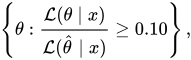
and more generally, a p% likelihood region for θ is defined[7][9] to be
- θ:L(θ∣x)L(θ^∣x)≥p100.displaystyle lefttheta :frac mathcal L(theta mid x)mathcal L(widehat theta mid x)geq frac p100right.
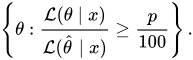
If θ is a single real parameter, a p% likelihood region will typically comprise an interval of real values. If the region does comprise an interval, then it is called a likelihood interval.[7][9][10]
Likelihood intervals can be compared to confidence intervals. If θ is a single real parameter, then under certain conditions, a 14.65% likelihood interval for θ will be the same as a 95% confidence interval.[7] In a slightly different formulation suited to the use of log-likelihoods (see Wilks' theorem), the test statistic is twice the difference in log-likelihoods and the probability distribution of the test statistic is approximately a chi-squared distribution with degrees-of-freedom (df) equal to the difference in df's between the two models (therefore, the e−2 likelihood interval is the same as the 0.954 confidence interval; assuming difference in df's to be 1).[10]
A likelihood interval can, and commonly is, used directly as an interval estimate, without claiming any particular coverage probability. As such, it differs from a confidence interval.
The relative likelihood is closely related to the likelihood ratio used in the likelihood-ratio test. The likelihood ratio is the ratio of any two specified likelihoods: 𝓛(θ0 | x) ∕𝓛(θ1 | x). The relative likelihood is the likelihood ratio with θ1=θ^displaystyle theta _1=widehat theta 
Relative likelihood of models
The definition of relative likelihood can be generalized to compare different statistical models. This generalization is based on AIC (Akaike information criterion), or sometimes AICc (Akaike Information Criterion with correction).
Suppose that, for some dataset, we have two statistical models, M1 and M2. Also suppose that AIC(M1) ≤ AIC(M2). Then the relative likelihood of M2 with respect to M1 is defined as follows.[12]
- exp(AIC(M1)−AIC(M2)2)displaystyle exp left(frac operatorname AIC (M_1)-operatorname AIC (M_2)2right)
- exp(AIC(M1)−AIC(M2)2)displaystyle exp left(frac operatorname AIC (M_1)-operatorname AIC (M_2)2right)
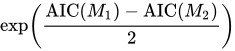
To see that this is a generalization of the earlier definition, suppose that we have some model M with a (possibly multivariate) parameter θ. Then for any θ, set M2 = M(θ), and also set M1=M(θ^)displaystyle M_1=M(widehat theta )
Likelihoods that eliminate nuisance parameters
In many cases, the likelihood is a function of more than one parameter but interest focuses on the estimation of only one, or at most a few of them, with the others being considered as nuisance parameters. Several alternative approaches have been developed to eliminate such nuisance parameters, so that a likelihood can be written as a function of only the parameter (or parameters) of interest: the main approaches are marginal, conditional, and profile likelihoods.[13][14]
These approaches are useful because standard likelihood methods can become unreliable or fail entirely when there are many nuisance parameters or when the nuisance parameters are high-dimensional. This is particularly true when the nuisance parameters can be considered to be "missing data"; they represent a non-negligible fraction of the number of observations and this fraction does not decrease when the sample size increases. Often these approaches can be used to derive closed-form formulae for statistical tests when direct use of maximum likelihood requires iterative numerical methods. These approaches find application in some specialized topics such as sequential analysis.
Conditional likelihood
Sometimes it is possible to find a sufficient statistic for the nuisance parameters, and conditioning on this statistic results in a likelihood which does not depend on the nuisance parameters.
One example occurs in 2×2 tables, where conditioning on all four marginal totals leads to a conditional likelihood based on the non-central hypergeometric distribution. This form of conditioning is also the basis for Fisher's exact test.
Marginal likelihood
Sometimes we can remove the nuisance parameters by considering a likelihood based on only part of the information in the data, for example by using the set of ranks rather than the numerical values. Another example occurs in linear mixed models, where considering a likelihood for the residuals only after fitting the fixed effects leads to residual maximum likelihood estimation of the variance components.
Profile likelihood
When the likelihood function depends on many parameters, depending on the application, we might be interested in only a subset of these parameters. It is often possible to reduce the number of the uninteresting (nuisance) parameters by writing them as functions of the parameters of interest. For example, the functions might be the value of the nuisance parameter which maximizes the likelihood given the value of the other (interesting) parameters.
This procedure is called concentration of the parameters and results in the concentrated likelihood function,[15] also occasionally known as the maximized likelihood function, but most often called the profile likelihood function. It is then possible (and simpler) to find the values of the parameters which maximizes the profile likelihood function (similar to the maximum likelihood).
For example, consider a regression analysis model with normally distributed errors. The most likely value of the error variance is the variance of the residuals. The residuals depend on all other parameters. Hence the variance parameter can be written as a function of the other parameters.
Unlike conditional and marginal likelihoods, profile likelihood methods can always be used, even when the profile likelihood cannot be written down explicitly. However, the profile likelihood is not a true likelihood, as it is not based directly on a probability distribution, and this leads to some less satisfactory properties. Attempts have been made to improve this, resulting in modified profile likelihood.[citation needed]
The idea of profile likelihood can also be used to compute confidence intervals that often have better small-sample properties than those based on asymptotic standard errors calculated from the full likelihood. In the case of parameter estimation in partially observed systems, the profile likelihood can be also used for identifiability analysis.[16]
Results from profile likelihood analysis can be incorporated in uncertainty analysis of model predictions.[17]
Partial likelihood
A partial likelihood is an adaption of the full likelihood such that only a part of the parameters (the parameters of interest) occur in it.[18] It is a key component of the proportional hazards model: using a restriction on the hazard function, the likelihood does not contain the shape of the hazard over time.
Historical remarks
The term "likelihood" has been in use in English since at least late Middle English.[19] Its formal use to refer to a specific function in mathematical statistics was proposed by Ronald Fisher,[20] in two research papers published in 1921[21] and 1922.[22] The 1921 paper introduced what is today called a "likelihood interval"; the 1922 paper introduced the term "method of maximum likelihood". Quoting Fisher:
[I]n 1922, I proposed the term ‘likelihood,’ in view of the fact that, with respect to [the parameter], it is not a probability, and does not obey the laws of probability, while at the same time it bears to the problem of rational choice among the possible values of [the parameter] a relation similar to that which probability bears to the problem of predicting events in games of chance. . . .Whereas, however, in relation to psychological judgment, likelihood has some resemblance to probability, the two concepts are wholly distinct. . . .”[23]
The 1921 paper introduced what is today called a "likelihood interval"; the 1922 paper introduced the term "method of maximum likelihood". Fisher's invention of statistical likelihood was in reaction against an earlier form of reasoning called inverse probability.[24] Fisher's use of the term "likelihood" fixed the meaning of the term within mathematical statistics.
A. W. F. Edwards established the axiomatic basis for use of the log-likelihood ratio as a measure of relative support for one hypothesis against another.[25] The support function is then the natural logarithm of the likelihood function. Both terms are used in phylogenetics, but were not adopted in a general treatment of the topic of statistical evidence.[26]
A more detailed discussion of the history of likelihood in statistics is given by the following sources.
.mw-parser-output .refbeginfont-size:90%;margin-bottom:0.5em.mw-parser-output .refbegin-hanging-indents>ullist-style-type:none;margin-left:0.mw-parser-output .refbegin-hanging-indents>ul>li,.mw-parser-output .refbegin-hanging-indents>dl>ddmargin-left:0;padding-left:3.2em;text-indent:-3.2em;list-style:none.mw-parser-output .refbegin-100font-size:100%
Hald, A. (1998), A History of Mathematical Statistics from 1750 to 1930, John Wiley & Sons, ISBN 0-471-17912-4.mw-parser-output cite.citationfont-style:inherit.mw-parser-output qquotes:"""""""'""'".mw-parser-output code.cs1-codecolor:inherit;background:inherit;border:inherit;padding:inherit.mw-parser-output .cs1-lock-free abackground:url("//upload.wikimedia.org/wikipedia/commons/thumb/6/65/Lock-green.svg/9px-Lock-green.svg.png")no-repeat;background-position:right .1em center.mw-parser-output .cs1-lock-limited a,.mw-parser-output .cs1-lock-registration abackground:url("//upload.wikimedia.org/wikipedia/commons/thumb/d/d6/Lock-gray-alt-2.svg/9px-Lock-gray-alt-2.svg.png")no-repeat;background-position:right .1em center.mw-parser-output .cs1-lock-subscription abackground:url("//upload.wikimedia.org/wikipedia/commons/thumb/a/aa/Lock-red-alt-2.svg/9px-Lock-red-alt-2.svg.png")no-repeat;background-position:right .1em center.mw-parser-output .cs1-subscription,.mw-parser-output .cs1-registrationcolor:#555.mw-parser-output .cs1-subscription span,.mw-parser-output .cs1-registration spanborder-bottom:1px dotted;cursor:help.mw-parser-output .cs1-hidden-errordisplay:none;font-size:100%.mw-parser-output .cs1-visible-errorfont-size:100%.mw-parser-output .cs1-subscription,.mw-parser-output .cs1-registration,.mw-parser-output .cs1-formatfont-size:95%.mw-parser-output .cs1-kern-left,.mw-parser-output .cs1-kern-wl-leftpadding-left:0.2em.mw-parser-output .cs1-kern-right,.mw-parser-output .cs1-kern-wl-rightpadding-right:0.2em.
Hald, A. (1999), "On the history of maximum likelihood in relation to inverse probability and least squares", Statistical Science, 14 (2): 214&ndash, 222, doi:10.1214/ss/1009212248, JSTOR 2676741.
Pratt, J. W. (May 1976), "F. Y. Edgeworth", The Annals of Statistics, 4 (3): 501&ndash, 514, doi:10.1214/aos/1176343457, JSTOR 2958222.
Stigler, S. M. (1978), "Francis Ysidro Edgeworth, Statistician", Journal of the Royal Statistical Society, Series A, 141 (3): 287&ndash, 322, doi:10.2307/2344804, JSTOR 2344804.
Stigler, S. M. (1986), The History of Statistics: The Measurement of Uncertainty before 1900, Harvard University Press, ISBN 0-674-40340-1.
Stigler, S. M. (1999), Statistics on the Table: The History of Statistical Concepts and Methods, Harvard University Press, ISBN 0-674-83601-4.
See also
- Bayes factor
- Bayesian inference
- Conditional entropy
- Conditional probability
- Empirical likelihood
- Likelihood principle
- Likelihood-ratio test
- Maximum likelihood
- Principle of maximum entropy
- Pseudolikelihood
- Score (statistics)
Notes
^ abc I. J. Good: Probability and the Weighing of Evidence (Griffin 1950), §6.1
^ abc H. Jeffreys: Theory of Probability (3rd ed., Oxford University Press 1983), §1.22
^ abcd E. T. Jaynes: Probability Theory: The Logic of Science (Cambridge University Press 2003), §4.1
^ abc D. V. Lindley: Introduction to Probability and Statistics from a Bayesian Viewpoint. Part 1: Probability (Cambridge University Press 1980), §1.6
^ abc A. Gelman, J. B. Carlin, H. S. Stern, D. B. Dunson, A. Vehtari, D. B. Rubin: Bayesian Data Analysis (3rd ed., Chapman & Hall/CRC 2014), §1.3
^ H. C. Sox, M. C. Higgins, D. K. Owens: Medical Decision Making (2nd ed., Wiley, 2013), http://doi.org/10.1002/9781118341544, chapters 3–4
^ abcd Kalbfleisch, J. G. (1985), Probability and Statistical Inference, Springer (§9.3).
^ Azzalini, A. (1996), Statistical Inference—Based on the likelihood, Chapman & Hall (§1.4.2).
^ abc Sprott, D. A. (2000), Statistical Inference in Science, Springer (chap. 2).
^ ab Hudson, D. J. (1971), "Interval estimation from the likelihood function", Journal of the Royal Statistical Society, Series B, 33 (2): 256–262.
^ Held, L.; Bové, D. S. (2014), Applied Statistical Inference, Springer (§2.1).
^ Burnham K. P. & Anderson D.R. (2002), Model Selection and Multimodel Inference, Springer (§2.8).
^
Pawitan, Yudi (2001). In All Likelihood: Statistical Modelling and Inference Using Likelihood. Oxford University Press. ISBN 0-19-850765-8.
^
Wen Hsiang Wei. "Generalized Linear Model - course notes". Tunghai University, Taichung, Taiwan. pp. Chapter 5. Retrieved 2017-10-01.
^ Montoya, Jose A.; Díaz-Francés, Eloísa; Sprott, David A. (2009). "On a criticism of the profile likelihood function". Statistical Papers. 50 (1): 195–202. doi:10.1007/s00362-007-0056-5.
^
Raue, A; Kreutz, C; Maiwald, T; Bachmann, J; Schilling, M; Klingmüller, U; Timmer, J (2009). "Structural and practical identifiability analysis of partially observed dynamical models by exploiting the profile likelihood". Bioinformatics. 25 (15): 1923–29. doi:10.1093/bioinformatics/btp358. PMID 19505944.
^
Vanlier, J; Tiemann, C; Hilbers, P; van Riel, N (2012). "An integrated strategy for prediction uncertainty analysis". Bioinformatics. 28 (8): 1130–35. doi:10.1093/bioinformatics/bts088. PMC 3324512. PMID 22355081.
^
Cox, D. R. (1975). "Partial likelihood". Biometrika. 62 (2): 269&ndash, 276. doi:10.1093/biomet/62.2.269. MR 0400509.
^ "likelihood", Shorter Oxford English Dictionary (2007).
^ Hald, A. (1999), "On the history of maximum likelihood in relation to inverse probability and least squares", Statistical Science, 14 (2): 214&ndash, 222, doi:10.1214/ss/1009212248, JSTOR 2676741.
^ Fisher, R.A. (1921), "On the "probable error" of a coefficient of correlation deduced from a small sample", Metron, 1: 3–32.
^ Fisher, R.A. (1922), "On the mathematical foundations of theoretical statistics", Philosophical Transactions of the Royal Society A, 222 (594–604): 309–368, doi:10.1098/rsta.1922.0009, JFM 48.1280.02, JSTOR 91208.
^ Klemens, Ben. Modeling with data: tools and techniques for scientific computing. Princeton University Press, 2008, p. 329.
^ Fienberg, Stephen E (1997). "Introduction to R.A. Fisher on inverse probability and likelihood". Statist. Sci. 12 (3): 161. doi:10.1214/ss/1030037905.
^ Edwards, A. W. F. 1972. Likelihood. Cambridge University Press (expanded edition, 1992, Johns Hopkins University Press).
ISBN 0-8018-4443-6
^ Royall, R. (1997). Statistical Evidence. Chapman & Hall.
Further reading
Fraser, D. A. S.; McDunnough, P.; Naderi, A.; Plante, A. (1995), "On the definition of probability densities and sufficiency of the likelihood map" (PDF), Probability and Mathematical Statistics, 15: 301–310.
Rohde, C. A. (2014), Introductory Statistical Inference with the Likelihood Function, Springer.
External links
 | Look up likelihood in Wiktionary, the free dictionary. |
- Likelihood function at Planetmath
Statistics | |||||||||||||||||||||||||||
|---|---|---|---|---|---|---|---|---|---|---|---|---|---|---|---|---|---|---|---|---|---|---|---|---|---|---|---|
*_Index">
| |||||||||||||||||||||||||||
| |||||||||||||||||||||||||||
| |||||||||||||||||||||||||||
| |||||||||||||||||||||||||||
| |||||||||||||||||||||||||||
| |||||||||||||||||||||||||||
| |||||||||||||||||||||||||||
| |||||||||||||||||||||||||||
 Category
 Portal
 Commons
 WikiProject


