Cumulant
In probability theory and statistics, the cumulants κn of a probability distribution are a set of quantities that provide an alternative to the moments of the distribution. The moments determine the cumulants in the sense that any two probability distributions whose moments are identical will have identical cumulants as well, and similarly the cumulants determine the moments.
The first cumulant is the mean, the second cumulant is the variance, and the third cumulant is the same as the third central moment. But fourth and higher-order cumulants are not equal to central moments. In some cases theoretical treatments of problems in terms of cumulants are simpler than those using moments. In particular, when two or more random variables are statistically independent, the nth-order cumulant of their sum is equal to the sum of their nth-order cumulants. As well, the third and higher-order cumulants of a normal distribution are zero, and it is the only distribution with this property.
Just as for moments, where joint moments are used for collections of random variables, it is possible to define joint cumulants.
Contents
1 Definition
1.1 Alternative definition of the cumulant generating function
2 Uses in statistics
3 Cumulants of some discrete probability distributions
4 Cumulants of some continuous probability distributions
5 Some properties of the cumulant generating function
6 Some properties of cumulants
6.1 Invariance and equivariance
6.2 Homogeneity
6.3 Additivity
6.4 A negative result
6.5 Cumulants and moments
6.6 Cumulants and set-partitions
6.7 Cumulants and combinatorics
7 Joint cumulants
7.1 Conditional cumulants and the law of total cumulance
8 Relation to statistical physics
9 History
10 Cumulants in generalized settings
10.1 Formal cumulants
10.2 Bell numbers
10.3 Cumulants of a polynomial sequence of binomial type
10.4 Free cumulants
11 See also
12 References
13 External links
Definition
The cumulants of a random variable X are defined using the cumulant-generating function K(t), which is the natural logarithm of the moment-generating function:
- K(t)=logE[etX].displaystyle K(t)=log operatorname E left[e^tXright].
![displaystyle K(t)=log operatorname E left[e^tXright].](https://wikimedia.org/api/rest_v1/media/math/render/svg/407afab9ff2a35388d3013f7c133178844b17fdb)
The cumulants κn are obtained from a power series expansion of the cumulant generating function:
- K(t)=∑n=1∞κntnn!=μt+σ2t22+⋯.displaystyle K(t)=sum _n=1^infty kappa _nfrac t^nn!=mu t+sigma ^2frac t^22+cdots .

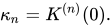
This expansion is a Maclaurin series, so the n-th cumulant can be obtained by differentiating the above expansion n times and evaluating the result at zero:[1]
- κn=K(n)(0).displaystyle kappa _n=K^(n)(0).
If the moment-generating function does not exist, the cumulants can be defined in terms of the relationship between cumulants and moments discussed later.
Alternative definition of the cumulant generating function
Some writers[2][3] prefer to define the cumulant-generating function as the natural logarithm of the characteristic function, which is sometimes also called the second characteristic function,[4][5]
- H(t)=logE[eitX]=∑n=1∞κn(it)nn!=μit−σ2t22+⋯displaystyle H(t)=log operatorname E left[e^itXright]=sum _n=1^infty kappa _nfrac (it)^nn!=mu it-sigma ^2frac t^22+cdots
![displaystyle H(t)=log operatorname E left[e^itXright]=sum _n=1^infty kappa _nfrac (it)^nn!=mu it-sigma ^2frac t^22+cdots](https://wikimedia.org/api/rest_v1/media/math/render/svg/1d1e3d1e389cd3ae8376b9c31b0368c9c4519646)
An advantage of H(t)—in some sense the function K(t) evaluated for purely imaginary arguments—is that E(eitX) is well defined for all real values of t even when E(etX) is not well defined for all real values of t, such as can occur when there is "too much" probability that X has a large magnitude. Although the function H(t) will be well defined, it will nonetheless mimic K(t) in terms of the length of its Maclaurin series, which may not extend beyond (or, rarely, even to) linear order in the argument t, and in particular the number of cumulants that are well defined will not change. Nevertheless, even when H(t) does not have a long Maclaurin series, it can be used directly in analyzing and, particularly, adding random variables. Both the Cauchy distribution (also called the Lorentzian) and more generally, stable distributions (related to the Lévy distribution) are examples of distributions for which the power-series expansions of the generating functions have only finitely many well-defined terms.
Uses in statistics
Working with cumulants can have an advantage over using moments because for statistically independent random variables X and Y,
- KX+Y(t)=logE[et(X+Y)]=log(E[etX]E[etY])=logE[etX]+logE[etY]=KX(t)+KY(t),displaystyle beginalignedK_X+Y(t)&=log operatorname E left[e^t(X+Y)right]\[5pt]&=log left(operatorname E left[e^tXright]operatorname E left[e^tYright]right)\[5pt]&=log operatorname E left[e^tXright]+log operatorname E left[e^tYright]\[5pt]&=K_X(t)+K_Y(t),endaligned
![displaystyle beginalignedK_X+Y(t)&=log operatorname E left[e^t(X+Y)right]\[5pt]&=log left(operatorname E left[e^tXright]operatorname E left[e^tYright]right)\[5pt]&=log operatorname E left[e^tXright]+log operatorname E left[e^tYright]\[5pt]&=K_X(t)+K_Y(t),endaligned](https://wikimedia.org/api/rest_v1/media/math/render/svg/839b2e386274beb3ba4151da6e6e16d034c4ec73)
so that each cumulant of a sum of independent random variables is the sum of the corresponding cumulants of the addends. That is, when the addends are statistically independent, the mean of the sum is the sum of the means, the variance of the sum is the sum of the variances, the third cumulant (which happens to be the third central moment) of the sum is the sum of the third cumulants, and so on for each order of cumulant.
A distribution with given cumulants κn can be approximated through an Edgeworth series.
Cumulants of some discrete probability distributions
- The constant random variables X = μ. The cumulant generating function is K(t) =μt. The first cumulant is κ1 = K '(0) = μ and the other cumulants are zero, κ2 = κ3 = κ4 = ... = 0.
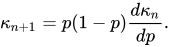
- The Bernoulli distributions, (number of successes in one trial with probability p of success). The cumulant generating function is K(t) = log(1 − p + pet). The first cumulants are κ1 = K '(0) = p and κ2 = K′′(0) = p·(1 − p). The cumulants satisfy a recursion formula
- κn+1=p(1−p)dκndp.displaystyle kappa _n+1=p(1-p)frac dkappa _ndp.
- κn+1=p(1−p)dκndp.displaystyle kappa _n+1=p(1-p)frac dkappa _ndp.
- The geometric distributions, (number of failures before one success with probability p of success on each trial). The cumulant generating function is K(t) = log(p / (1 + (p − 1)et)). The first cumulants are κ1 = K′(0) = p−1 − 1, and κ2 = K′′(0) = κ1p−1. Substituting p = (μ + 1)−1 gives K(t) = −log(1 + μ(1−et)) and κ1 = μ.
- The Poisson distributions. The cumulant generating function is K(t) = μ(et − 1). All cumulants are equal to the parameter: κ1 = κ2 = κ3 = ... = μ.
- The binomial distributions, (number of successes in n independent trials with probability p of success on each trial). The special case n = 1 is a Bernoulli distribution. Every cumulant is just n times the corresponding cumulant of the corresponding Bernoulli distribution. The cumulant generating function is K(t) = n log(1 − p + pet). The first cumulants are κ1 = K′(0) = np and κ2 = K′′(0) = κ1(1 − p). Substituting p = μ·n−1 gives K '(t) = ((μ−1 − n−1)·e−t + n−1)−1 and κ1 = μ. The limiting case n−1 = 0 is a Poisson distribution.
- The negative binomial distributions, (number of failures before n successes with probability p of success on each trial). The special case n = 1 is a geometric distribution. Every cumulant is just n times the corresponding cumulant of the corresponding geometric distribution. The derivative of the cumulant generating function is K '(t) = n·((1 − p)−1·e−t−1)−1. The first cumulants are κ1 = K '(0) = n·(p−1−1), and κ2 = K ' '(0) = κ1·p−1. Substituting p = (μ·n−1+1)−1 gives K′(t) = ((μ−1 + n−1)e−t − n−1)−1 and κ1 = μ. Comparing these formulas to those of the binomial distributions explains the name 'negative binomial distribution'. The limiting case n−1 = 0 is a Poisson distribution.
Introducing the variance-to-mean ratio
- ε=μ−1σ2=κ1−1κ2,displaystyle varepsilon =mu ^-1sigma ^2=kappa _1^-1kappa _2,

the above probability distributions get a unified formula for the derivative of the cumulant generating function:[citation needed]
- K′(t)=μ⋅(1+ε⋅(e−t−1))−1.displaystyle K'(t)=mu cdot (1+varepsilon cdot (e^-t-1))^-1.

The second derivative is
- K″(t)=g′(t)⋅(1+et⋅(ε−1−1))−1displaystyle K''(t)=g'(t)cdot (1+e^tcdot (varepsilon ^-1-1))^-1

confirming that the first cumulant is κ1 = K′(0) = μ and the second cumulant is κ2 = K′′(0) = με. The constant random variables X = μ have ε = 0. The binomial distributions have ε = 1 − p so that 0 < ε < 1. The Poisson distributions have ε = 1. The negative binomial distributions have ε = p−1 so that ε > 1. Note the analogy to the classification of conic sections by eccentricity: circles ε = 0, ellipses 0 < ε < 1, parabolas ε = 1, hyperbolas ε > 1.
Cumulants of some continuous probability distributions
- For the normal distribution with expected value μ and variance σ2, the cumulant generating function is K(t) = μt + σ2t2/2. The first and second derivatives of the cumulant generating function are K '(t) = μ + σ2·t and K"(t) = σ2. The cumulants are κ1 = μ, κ2 = σ2, and κ3 = κ4 = ... = 0. The special case σ2 = 0 is a constant random variable X = μ.
- The cumulants of the uniform distribution on the interval [−1, 0] are κn = Bn/n, where Bn is the n-th Bernoulli number.
- The cumulants of the exponential distribution with parameter λ are κn = λ−n (n − 1)!.
Some properties of the cumulant generating function
The cumulant generating function K(t), if it exists, is infinitely differentiable and convex, and passes through the origin. Its first derivative ranges monotonically in the open interval from the infimum to the supremum of the support of the probability distribution, and its second derivative is strictly positive everywhere it is defined, except for the degenerate distribution of a single point mass. The cumulant-generating function exists if and only if the tails of the distribution are majorized by an exponential decay, that is, (see Big O notation,)
- ∃c>0,F(x)=O(ecx),x→−∞; and∃d>0,1−F(x)=O(e−dx),x→+∞;displaystyle beginaligned&exists c>0,,,F(x)=O(e^cx),xto -infty ;text and\[4pt]&exists d>0,,,1-F(x)=O(e^-dx),xto +infty ;endaligned
![displaystyle beginaligned&exists c>0,,,F(x)=O(e^cx),xto -infty ;text and\[4pt]&exists d>0,,,1-F(x)=O(e^-dx),xto +infty ;endaligned](https://wikimedia.org/api/rest_v1/media/math/render/svg/6d786b0897af83338be865f904605ab2fc234556)
where Fdisplaystyle F
If the support of a random variable X has finite upper or lower bounds, then its cumulant-generating function y = K(t), if it exists, approaches asymptote(s) whose slope is equal to the supremum and/or infimum of the support,
- y=(t+1)infsuppX−μ(X), andy=(t−1)supsuppX+μ(X),displaystyle beginalignedy&=(t+1)inf operatorname supp X-mu (X),text and\[5pt]y&=(t-1)sup operatorname supp X+mu (X),endaligned
![displaystyle beginalignedy&=(t+1)inf operatorname supp X-mu (X),text and\[5pt]y&=(t-1)sup operatorname supp X+mu (X),endaligned](https://wikimedia.org/api/rest_v1/media/math/render/svg/309ec8a33da97475561a69311af4608aba7f4d0b)
respectively, lying above both these lines everywhere. (The integrals
- ∫−∞0[tinfsuppX−K′(t)]dt,∫∞0[tinfsuppX−K′(t)]dtdisplaystyle int _-infty ^0left[tinf operatorname supp X-K'(t)right],dt,qquad int _infty ^0left[tinf operatorname supp X-K'(t)right],dt
![displaystyle int _-infty ^0left[tinf operatorname supp X-K'(t)right],dt,qquad int _infty ^0left[tinf operatorname supp X-K'(t)right],dt](https://wikimedia.org/api/rest_v1/media/math/render/svg/780c93ce7fb04d26d06d13fd077cfb0f168913af)
yield the y-intercepts of these asymptotes, since K(0) = 0.)
For a shift of the distribution by c, KX+c(t)=KX(t)+ct.displaystyle K_X+c(t)=K_X(t)+ct.


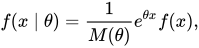
The natural exponential family of a distribution may be realized by shifting or translating K(t), and adjusting it vertically so that it always passes through the origin: if f is the pdf with cgf K(t)=logM(t),displaystyle K(t)=log M(t),


If K(t) is finite for a range t1 < Re(t) < t2 then if t1 < 0 < t2 then K(t) is analytic and infinitely differentiable for t1 < Re(t) < t2. Moreover for t real and t1 < t < t2K(t) is strictly convex, and K'(t) is strictly increasing.[citation needed]
Some properties of cumulants
Invariance and equivariance
The first cumulant is shift-equivariant; all of the others are shift-invariant. This means that, if we denote by κn(X) the n-th cumulant of the probability distribution of the random variable X, then for any constant c:
- κ1(X+c)=κ1(X)+c anddisplaystyle kappa _1(X+c)=kappa _1(X)+c~text and
- κn(X+c)=κn(X) for n≥2.displaystyle kappa _n(X+c)=kappa _n(X)~text for ~ngeq 2.


In other words, shifting a random variable (adding c) shifts the first cumulant (the mean) and doesn't affect any of the others.
Homogeneity
The n-th cumulant is homogeneous of degree n, i.e. if c is any constant, then
- κn(cX)=cnκn(X).displaystyle kappa _n(cX)=c^nkappa _n(X).

Additivity
If X and Y are independent random variables then κn(X + Y) = κn(X) + κn(Y).
A negative result
Given the results for the cumulants of the normal distribution, it might be hoped to find families of distributions for which
κm = κm+1 = ⋯ = 0 for some m > 3, with the lower-order cumulants (orders 3 to m − 1) being non-zero. There are no such distributions.[7] The underlying result here is that the cumulant generating function cannot be a finite-order polynomial of degree greater than 2.
Cumulants and moments
The moment generating function is given by:
- M(t)=1+∑n=1∞μn′tnn!=exp(∑n=1∞κntnn!)=exp(K(t)).displaystyle M(t)=1+sum _n=1^infty frac mu '_nt^nn!=exp left(sum _n=1^infty frac kappa _nt^nn!right)=exp(K(t)).

So the cumulant generating function is the logarithm of the moment generating function
- K(t)=logM(t).displaystyle K(t)=log M(t).

The first cumulant is the expected value; the second and third cumulants are respectively the second and third central moments (the second central moment is the variance); but the higher cumulants are neither moments nor central moments, but rather more complicated polynomial functions of the moments.
The moments can be recovered in terms of cumulants by evaluating the n-th derivative of exp(K(t))displaystyle exp(K(t))

- μn′=M(n)(0)=dnexp(K(t))dtn|t=0.displaystyle mu '_n=M^(n)(0)=left.frac mathrm d ^nexp(K(t))mathrm d t^nright

Likewise, the cumulants can be recovered in terms of moments by evaluating the n-th derivative of logM(t)displaystyle log M(t)
- κn=K(n)(0)=dnlogM(t)dtn|t=0.displaystyle kappa _n=K^(n)(0)=left.frac mathrm d ^nlog M(t)mathrm d t^nright

The explicit expression for the n-th moment in terms of the first n cumulants, and vice versa, can be obtained by using Faà di Bruno's formula for higher derivatives of composite functions. In general, we have
- μn′=∑k=1nBn,k(κ1,…,κn−k+1)displaystyle mu '_n=sum _k=1^nB_n,k(kappa _1,ldots ,kappa _n-k+1)
- κn=∑k=1n(−1)k−1(k−1)!Bn,k(μ1′,…,μn−k+1′),displaystyle kappa _n=sum _k=1^n(-1)^k-1(k-1)!B_n,k(mu '_1,ldots ,mu '_n-k+1),
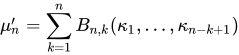

where Bn,kdisplaystyle B_n,k
In the like manner, if the mean is given by μdisplaystyle mu 
- C(t)=E[et(x−μ)]=e−μtM(t)=exp(K(t)−μt),displaystyle C(t)=operatorname E [e^t(x-mu )]=e^-mu tM(t)=exp(K(t)-mu t),
![displaystyle C(t)=operatorname E [e^t(x-mu )]=e^-mu tM(t)=exp(K(t)-mu t),](https://wikimedia.org/api/rest_v1/media/math/render/svg/ff5b8e3bcc258db5045d1c7fe1d9bb22b63a162c)
and the n-th central moment is obtained in terms of cumulants as
- μn=C(n)(0)=dndtnexp(K(t)−μt)|t=0=∑k=1nBn,k(0,κ2,…,κn−k+1)._t=0=sum _k=1^nB_n,k(0,kappa _2,ldots ,kappa _n-k+1).

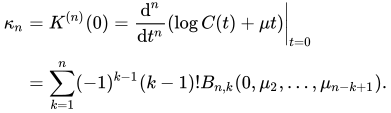
Also, for n > 1, the n-th cumulant in terms of the central moments is
- κn=K(n)(0)=dndtn(logC(t)+μt)|t=0=∑k=1n(−1)k−1(k−1)!Bn,k(0,μ2,…,μn−k+1).displaystyle beginalignedkappa _n&=K^(n)(0)=left.frac mathrm d ^nmathrm d t^n(log C(t)+mu t)right
The n-th moment μ′n is an nth-degree polynomial in the first n cumulants. The first few expressions are:
- μ1′=κ1μ2′=κ2+κ12μ3′=κ3+3κ2κ1+κ13μ4′=κ4+4κ3κ1+3κ22+6κ2κ12+κ14μ5′=κ5+5κ4κ1+10κ3κ2+10κ3κ12+15κ22κ1+10κ2κ13+κ15μ6′=κ6+6κ5κ1+15κ4κ2+15κ4κ12+10κ32+60κ3κ2κ1+20κ3κ13+15κ23+45κ22κ12+15κ2κ14+κ16.displaystyle beginalignedmu '_1=&kappa _1\[5pt]mu '_2=&kappa _2+kappa _1^2\[5pt]mu '_3=&kappa _3+3kappa _2kappa _1+kappa _1^3\[5pt]mu '_4=&kappa _4+4kappa _3kappa _1+3kappa _2^2+6kappa _2kappa _1^2+kappa _1^4\[5pt]mu '_5=&kappa _5+5kappa _4kappa _1+10kappa _3kappa _2+10kappa _3kappa _1^2+15kappa _2^2kappa _1+10kappa _2kappa _1^3+kappa _1^5\[5pt]mu '_6=&kappa _6+6kappa _5kappa _1+15kappa _4kappa _2+15kappa _4kappa _1^2+10kappa _3^2+60kappa _3kappa _2kappa _1+20kappa _3kappa _1^3\&+15kappa _2^3+45kappa _2^2kappa _1^2+15kappa _2kappa _1^4+kappa _1^6.endaligned
![displaystyle beginalignedmu '_1=&kappa _1\[5pt]mu '_2=&kappa _2+kappa _1^2\[5pt]mu '_3=&kappa _3+3kappa _2kappa _1+kappa _1^3\[5pt]mu '_4=&kappa _4+4kappa _3kappa _1+3kappa _2^2+6kappa _2kappa _1^2+kappa _1^4\[5pt]mu '_5=&kappa _5+5kappa _4kappa _1+10kappa _3kappa _2+10kappa _3kappa _1^2+15kappa _2^2kappa _1+10kappa _2kappa _1^3+kappa _1^5\[5pt]mu '_6=&kappa _6+6kappa _5kappa _1+15kappa _4kappa _2+15kappa _4kappa _1^2+10kappa _3^2+60kappa _3kappa _2kappa _1+20kappa _3kappa _1^3\&+15kappa _2^3+45kappa _2^2kappa _1^2+15kappa _2kappa _1^4+kappa _1^6.endaligned](https://wikimedia.org/api/rest_v1/media/math/render/svg/09a0e224da9567adc36e1dceef731d0a716d3c2c)
The "prime" distinguishes the moments μ′n from the central moments μn. To express the central moments as functions of the cumulants, just drop from these polynomials all terms in which κ1 appears as a factor:
- μ1=0μ2=κ2μ3=κ3μ4=κ4+3κ22μ5=κ5+10κ3κ2μ6=κ6+15κ4κ2+10κ32+15κ23.displaystyle beginalignedmu _1&=0\[4pt]mu _2&=kappa _2\[4pt]mu _3&=kappa _3\[4pt]mu _4&=kappa _4+3kappa _2^2\[4pt]mu _5&=kappa _5+10kappa _3kappa _2\[4pt]mu _6&=kappa _6+15kappa _4kappa _2+10kappa _3^2+15kappa _2^3.endaligned
![displaystyle beginalignedmu _1&=0\[4pt]mu _2&=kappa _2\[4pt]mu _3&=kappa _3\[4pt]mu _4&=kappa _4+3kappa _2^2\[4pt]mu _5&=kappa _5+10kappa _3kappa _2\[4pt]mu _6&=kappa _6+15kappa _4kappa _2+10kappa _3^2+15kappa _2^3.endaligned](https://wikimedia.org/api/rest_v1/media/math/render/svg/68158b6d00b076a0916eb6bb7669096847d0b828)
Similarly, the n-th cumulant κn is an n-th-degree polynomial in the first n non-central moments. The first few expressions are:
- κ1=μ1′κ2=μ2′−μ1′2κ3=μ3′−3μ2′μ1′+2μ1′3κ4=μ4′−4μ3′μ1′−3μ2′2+12μ2′μ1′2−6μ1′4κ5=μ5′−5μ4′μ1′−10μ3′μ2′+20μ3′μ1′2+30μ2′2μ1′−60μ2′μ1′3+24μ1′5κ6=μ6′−6μ5′μ1′−15μ4′μ2′+30μ4′μ1′2−10μ3′2+120μ3′μ2′μ1′−120μ3′μ1′3+30μ2′3−270μ2′2μ1′2+360μ2′μ1′4−120μ1′6displaystyle beginalignedkappa _1=&mu '_1\[4pt]kappa _2=&mu '_2-mu '_1^2\[4pt]kappa _3=&mu '_3-3mu '_2mu '_1+2mu '_1^3\[4pt]kappa _4=&mu '_4-4mu '_3mu '_1-3mu '_2^2+12mu '_2mu '_1^2-6mu '_1^4\[4pt]kappa _5=&mu '_5-5mu '_4mu '_1-10mu '_3mu '_2+20mu '_3mu '_1^2+30mu '_2^2mu '_1-60mu '_2mu '_1^3+24mu '_1^5\[4pt]kappa _6=&mu '_6-6mu '_5mu '_1-15mu '_4mu '_2+30mu '_4mu '_1^2-10mu '_3^2+120mu '_3mu '_2mu '_1\&-120mu '_3mu '_1^3+30mu '_2^3-270mu '_2^2mu '_1^2+360mu '_2mu '_1^4-120mu '_1^6endaligned
![displaystyle beginalignedkappa _1=&mu '_1\[4pt]kappa _2=&mu '_2-mu '_1^2\[4pt]kappa _3=&mu '_3-3mu '_2mu '_1+2mu '_1^3\[4pt]kappa _4=&mu '_4-4mu '_3mu '_1-3mu '_2^2+12mu '_2mu '_1^2-6mu '_1^4\[4pt]kappa _5=&mu '_5-5mu '_4mu '_1-10mu '_3mu '_2+20mu '_3mu '_1^2+30mu '_2^2mu '_1-60mu '_2mu '_1^3+24mu '_1^5\[4pt]kappa _6=&mu '_6-6mu '_5mu '_1-15mu '_4mu '_2+30mu '_4mu '_1^2-10mu '_3^2+120mu '_3mu '_2mu '_1\&-120mu '_3mu '_1^3+30mu '_2^3-270mu '_2^2mu '_1^2+360mu '_2mu '_1^4-120mu '_1^6endaligned](https://wikimedia.org/api/rest_v1/media/math/render/svg/efb59374c011b53065bed8093dfe30e814e2acde)
To express the cumulants κn for n > 1 as functions of the central moments, drop from these polynomials all terms in which μ'1 appears as a factor:
- κ2=μ2displaystyle kappa _2=mu _2,
- κ3=μ3displaystyle kappa _3=mu _3,
- κ4=μ4−3μ22displaystyle kappa _4=mu _4-3mu _2^2,
- κ5=μ5−10μ3μ2displaystyle kappa _5=mu _5-10mu _3mu _2,
- κ6=μ6−15μ4μ2−10μ32+30μ23.displaystyle kappa _6=mu _6-15mu _4mu _2-10mu _3^2+30mu _2^3,.





To express the cumulants κn for n > 2 as functions of the standardized central moments, also set μ'2=1 in the polynomials:
- κ3=μ3displaystyle kappa _3=mu _3,
- κ4=μ4−3displaystyle kappa _4=mu _4-3,
- κ5=μ5−10μ3displaystyle kappa _5=mu _5-10mu _3,
- κ6=μ6−15μ4−10μ32+30.displaystyle kappa _6=mu _6-15mu _4-10mu _3^2+30,.



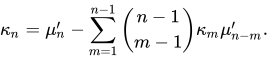
The cumulants are also related to the moments by the following recursion formula:
- κn=μn′−∑m=1n−1(n−1m−1)κmμn−m′.displaystyle kappa _n=mu '_n-sum _m=1^n-1n-1 choose m-1kappa _mmu _n-m'.
Cumulants and set-partitions
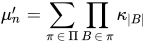
These polynomials have a remarkable combinatorial interpretation: the coefficients count certain partitions of sets. A general form of these polynomials is
- μn′=∑π∈Π∏B∈πκ|B|displaystyle mu '_n=sum _pi ,in ,Pi prod _B,in ,pi kappa _
where
π runs through the list of all partitions of a set of size n;- "B ∈ π" means B is one of the "blocks" into which the set is partitioned; and
|B| is the size of the set B.
Thus each monomial is a constant times a product of cumulants in which the sum of the indices is n (e.g., in the term κ3κ22κ1, the sum of the indices is 3 + 2 + 2 + 1 = 8; this appears in the polynomial that expresses the 8th moment as a function of the first eight cumulants). A partition of the integer n corresponds to each term. The coefficient in each term is the number of partitions of a set of n members that collapse to that partition of the integer n when the members of the set become indistinguishable.
Cumulants and combinatorics
Further connection between cumulants and combinatorics can be found in the work of Gian-Carlo Rota and Jianhong (Jackie) Shen, where links to invariant theory, symmetric functions, and binomial sequences are studied via umbral calculus.[8]
Joint cumulants
The joint cumulant of several random variables X1, ..., Xn is defined by a similar cumulant generating function
- K(t1,t2,…,tn)=logE(e∑j=1ntjXj).displaystyle K(t_1,t_2,dots ,t_n)=log E(mathrm e ^sum _j=1^nt_jX_j).

A consequence is that
- κ(X1,…,Xn)=∑π(|π|−1)!(−1)|π|−1∏B∈πE(∏i∈BXi)-1)!(-1)^-1prod _Bin pi Eleft(prod _iin BX_iright)

where π runs through the list of all partitions of 1, ..., n , B runs through the list of all blocks of the partition π, and |π| is the number of parts in the partition. For example,
- κ(X,Y,Z)=E(XYZ)−E(XY)E(Z)−E(XZ)E(Y)−E(YZ)E(X)+2E(X)E(Y)E(Z).displaystyle kappa (X,Y,Z)=operatorname E (XYZ)-operatorname E (XY)operatorname E (Z)-operatorname E (XZ)operatorname E (Y)-operatorname E (YZ)operatorname E (X)+2operatorname E (X)operatorname E (Y)operatorname E (Z).,

If any of these random variables are identical, e.g. if X = Y, then the same formulae apply, e.g.
- κ(X,X,Z)=E(X2Z)−2E(XZ)E(X)−E(X2)E(Z)+2E(X)2E(Z),displaystyle kappa (X,X,Z)=operatorname E (X^2Z)-2operatorname E (XZ)operatorname E (X)-operatorname E (X^2)operatorname E (Z)+2operatorname E (X)^2operatorname E (Z),,

although for such repeated variables there are more concise formulae. For zero-mean random vectors,
- κ(X,Y,Z)=E(XYZ).displaystyle kappa (X,Y,Z)=operatorname E (XYZ).,
- κ(X,Y,Z,W)=E(XYZW)−E(XY)E(ZW)−E(XZ)E(YW)−E(XW)E(YZ).displaystyle kappa (X,Y,Z,W)=operatorname E (XYZW)-operatorname E (XY)operatorname E (ZW)-operatorname E (XZ)operatorname E (YW)-operatorname E (XW)operatorname E (YZ).,


The joint cumulant of just one random variable is its expected value, and that of two random variables is their covariance. If some of the random variables are independent of all of the others, then any cumulant involving two (or more) independent random variables is zero. If all n random variables are the same, then the joint cumulant is the n-th ordinary cumulant.
The combinatorial meaning of the expression of moments in terms of cumulants is easier to understand than that of cumulants in terms of moments:
- E(X1⋯Xn)=∑π∏B∈πκ(Xi:i∈B).displaystyle operatorname E (X_1cdots X_n)=sum _pi prod _Bin pi kappa (X_i:iin B).

For example:
- E(XYZ)=κ(X,Y,Z)+κ(X,Y)κ(Z)+κ(X,Z)κ(Y)+κ(Y,Z)κ(X)+κ(X)κ(Y)κ(Z).displaystyle operatorname E (XYZ)=kappa (X,Y,Z)+kappa (X,Y)kappa (Z)+kappa (X,Z)kappa (Y)+kappa (Y,Z)kappa (X)+kappa (X)kappa (Y)kappa (Z).,

Another important property of joint cumulants is multilinearity:
- κ(X+Y,Z1,Z2,…)=κ(X,Z1,Z2,…)+κ(Y,Z1,Z2,…).displaystyle kappa (X+Y,Z_1,Z_2,dots )=kappa (X,Z_1,Z_2,ldots )+kappa (Y,Z_1,Z_2,ldots ).,

Just as the second cumulant is the variance, the joint cumulant of just two random variables is the covariance. The familiar identity
- var(X+Y)=var(X)+2cov(X,Y)+var(Y)displaystyle operatorname var (X+Y)=operatorname var (X)+2operatorname cov (X,Y)+operatorname var (Y),

generalizes to cumulants:
- κn(X+Y)=∑j=0n(nj)κ(X,…,X⏟j,Y,…,Y⏟n−j).displaystyle kappa _n(X+Y)=sum _j=0^nn choose jkappa (,underbrace X,dots ,X _j,underbrace Y,dots ,Y _n-j,).,

Conditional cumulants and the law of total cumulance
The law of total expectation and the law of total variance generalize naturally to conditional cumulants. The case n = 3, expressed in the language of (central) moments rather than that of cumulants, says
- μ3(X)=E(μ3(X∣Y))+μ3(E(X∣Y))+3cov(E(X∣Y),var(X∣Y)).displaystyle mu _3(X)=operatorname E (mu _3(Xmid Y))+mu _3(operatorname E (Xmid Y))+3operatorname cov (operatorname E (Xmid Y),operatorname var (Xmid Y)).

In general,[9]
- κ(X1,…,Xn)=∑πκ(κ(Xπ1∣Y),…,κ(Xπb∣Y))displaystyle kappa (X_1,dots ,X_n)=sum _pi kappa (kappa (X_pi _1mid Y),dots ,kappa (X_pi _bmid Y))

where
- the sum is over all partitions π of the set 1, ..., n of indices, and
π1, ..., πb are all of the "blocks" of the partition π; the expression κ(Xπm) indicates that the joint cumulant of the random variables whose indices are in that block of the partition.
Relation to statistical physics
In statistical physics many extensive quantities – that is quantities that are proportional to the volume or size of a given system – are related to cumulants of random variables. The deep connection is that in a large system an extensive quantity like the energy or number of particles can be thought of as the sum of (say) the energy associated with a number of nearly independent regions. The fact that the cumulants of these nearly independent random variables will (nearly) add make it reasonable that extensive quantities should be expected to be related to cumulants.
A system in equilibrium with a thermal bath at temperature T can occupy states of energy E. The energy E can be considered a random variable, having the probability density. The partition function of the system is
- Z(β)=⟨exp(−βE)⟩,displaystyle Z(beta )=langle exp(-beta E)rangle ,,

where β = 1/(kT) and k is Boltzmann's constant and the notation ⟨A⟩displaystyle langle Arangle 
![displaystyle operatorname E [A]](https://wikimedia.org/api/rest_v1/media/math/render/svg/39d9a81230f701141bbdef64c5a672769b3c998b)
- F(β)=−β−1logZdisplaystyle F(beta )=-beta ^-1log Z,

and is clearly very closely related to the cumulant generating function for the energy. The free energy gives access to all of the thermodynamics properties of the system via its first second and higher order derivatives, such as its internal energy, entropy, and specific heat. Because of the relationship between the free energy and the cumulant generating function, all these quantities are related to cumulants e.g. the energy and specific heat are given by
- E=⟨E⟩cdisplaystyle E=langle Erangle _c
- C=dE/dT=kβ2⟨E2⟩c=kβ2(⟨E2⟩−⟨E⟩2)displaystyle C=dE/dT=kbeta ^2langle E^2rangle _c=kbeta ^2(langle E^2rangle -langle Erangle ^2)


and ⟨E2⟩cdisplaystyle langle E^2rangle _c
- Ω=−β−1log(⟨exp(−βE−βμN)⟩),displaystyle Omega =-beta ^-1log(langle exp(-beta E-beta mu N)rangle ),,

where N is the number of particles and Ωdisplaystyle Omega 
History
The history of cumulants is discussed by Anders Hald.[10][11]
Cumulants were first introduced by Thorvald N. Thiele, in 1889, who called them semi-invariants.[12] They were first called cumulants in a 1932 paper[13] by Ronald Fisher and John Wishart. Fisher was publicly reminded of Thiele's work by Neyman, who also notes previous published citations of Thiele brought to Fisher's attention.[14]Stephen Stigler has said[citation needed] that the name cumulant was suggested to Fisher in a letter from Harold Hotelling. In a paper published in 1929,[15] Fisher had called them cumulative moment functions. The partition function in statistical physics was introduced by Josiah Willard Gibbs in 1901.[citation needed] The free energy is often called Gibbs free energy. In statistical mechanics, cumulants are also known as Ursell functions relating to a publication in 1927.[citation needed]
Cumulants in generalized settings
Formal cumulants
More generally, the cumulants of a sequence mn : n = 1, 2, 3, ... , not necessarily the moments of any probability distribution, are, by definition,
- 1+∑n=1∞mntnn!=exp(∑n=1∞κntnn!),displaystyle 1+sum _n=1^infty frac m_nt^nn!=exp left(sum _n=1^infty frac kappa _nt^nn!right),
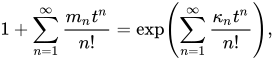
where the values of κn for n = 1, 2, 3, ... are found formally, i.e., by algebra alone, in disregard of questions of whether any series converges. All of the difficulties of the "problem of cumulants" are absent when one works formally. The simplest example is that the second cumulant of a probability distribution must always be nonnegative, and is zero only if all of the higher cumulants are zero. Formal cumulants are subject to no such constraints.
Bell numbers
In combinatorics, the n-th Bell number is the number of partitions of a set of size n. All of the cumulants of the sequence of Bell numbers are equal to 1. The Bell numbers are the moments of the Poisson distribution with expected value 1.
Cumulants of a polynomial sequence of binomial type
For any sequence κn : n = 1, 2, 3, ... of scalars in a field of characteristic zero, being considered formal cumulants, there is a corresponding sequence μ ′ : n = 1, 2, 3, ... of formal moments, given by the polynomials above.[clarification needed][citation needed] For those polynomials, construct a polynomial sequence in the following way. Out of the polynomial
- μ6′=κ6+6κ5κ1+15κ4κ2+15κ4κ12+10κ32+60κ3κ2κ1+20κ3κ13+15κ23+45κ22κ12+15κ2κ14+κ16displaystyle beginalignedmu '_6=&kappa _6+6kappa _5kappa _1+15kappa _4kappa _2+15kappa _4kappa _1^2+10kappa _3^2+60kappa _3kappa _2kappa _1+20kappa _3kappa _1^3\&+15kappa _2^3+45kappa _2^2kappa _1^2+15kappa _2kappa _1^4+kappa _1^6endaligned

make a new polynomial in these plus one additional variable x:
- p6(x)=κ6x+(6κ5κ1+15κ4κ2+10κ32)x2+(15κ4κ12+60κ3κ2κ1+15κ23)x3+(45κ22κ12)x4+(15κ2κ14)x5+(κ16)x6,displaystyle beginalignedp_6(x)=&kappa _6,x+(6kappa _5kappa _1+15kappa _4kappa _2+10kappa _3^2),x^2+(15kappa _4kappa _1^2+60kappa _3kappa _2kappa _1+15kappa _2^3),x^3\&+(45kappa _2^2kappa _1^2),x^4+(15kappa _2kappa _1^4),x^5+(kappa _1^6),x^6,endaligned

and then generalize the pattern. The pattern is that the numbers of blocks in the aforementioned partitions are the exponents on x. Each coefficient is a polynomial in the cumulants; these are the Bell polynomials, named after Eric Temple Bell.[citation needed]
This sequence of polynomials is of binomial type. In fact, no other sequences of binomial type exist; every polynomial sequence of binomial type is completely determined by its sequence of formal cumulants.[citation needed]
Free cumulants
In the above moment-cumulant formula
- E(X1⋯Xn)=∑π∏B∈πκ(Xi:i∈B)displaystyle E(X_1cdots X_n)=sum _pi prod _B,in ,pi kappa (X_i:iin B)

for joint cumulants,
one sums over all partitions of the set 1, ..., n . If instead, one sums only over the noncrossing partitions, then, by solving these formulae for the κdisplaystyle kappa 
The ordinary cumulants of degree higher than 2 of the normal distribution are zero. The free cumulants of degree higher than 2 of the Wigner semicircle distribution are zero.[17] This is one respect in which the role of the Wigner distribution in free probability theory is analogous to that of the normal distribution in conventional probability theory.
See also
- Entropic value at risk
- Cumulant generating function from a multiset
- Cornish–Fisher expansion
- Edgeworth expansion
- Polykay
k-statistic, a minimum-variance unbiased estimator of a cumulant- Ursell function
Total position spread tensor as an application of cumulants to analyse the electronic wave function in quantum chemistry.
References
^ Weisstein, Eric W. "Cumulant". From MathWorld – A Wolfram Web Resource. http://mathworld.wolfram.com/Cumulant.html
^ Kendall, M. G., Stuart, A. (1969) The Advanced Theory of Statistics, Volume 1 (3rd Edition). Griffin, London. (Section 3.12)
^ Lukacs, E. (1970) Characteristic Functions (2nd Edition). Griffin, London. (Page 27)
^ Lukacs, E. (1970) Characteristic Functions (2nd Edition). Griffin, London. (Section 2.4)
^ Aapo Hyvarinen, Juha Karhunen, and Erkki Oja (2001) Independent Component Analysis, John Wiley & Sons. (Section 2.7.2)
^ Hamedani, G. G.; Volkmer, Hans; Behboodian, J. (2012-03-01). "A note on sub-independent random variables and a class of bivariate mixtures". Studia Scientiarum Mathematicarum Hungarica. 49 (1): 19–25. doi:10.1556/SScMath.2011.1183..mw-parser-output cite.citationfont-style:inherit.mw-parser-output qquotes:"""""""'""'".mw-parser-output code.cs1-codecolor:inherit;background:inherit;border:inherit;padding:inherit.mw-parser-output .cs1-lock-free abackground:url("//upload.wikimedia.org/wikipedia/commons/thumb/6/65/Lock-green.svg/9px-Lock-green.svg.png")no-repeat;background-position:right .1em center.mw-parser-output .cs1-lock-limited a,.mw-parser-output .cs1-lock-registration abackground:url("//upload.wikimedia.org/wikipedia/commons/thumb/d/d6/Lock-gray-alt-2.svg/9px-Lock-gray-alt-2.svg.png")no-repeat;background-position:right .1em center.mw-parser-output .cs1-lock-subscription abackground:url("//upload.wikimedia.org/wikipedia/commons/thumb/a/aa/Lock-red-alt-2.svg/9px-Lock-red-alt-2.svg.png")no-repeat;background-position:right .1em center.mw-parser-output .cs1-subscription,.mw-parser-output .cs1-registrationcolor:#555.mw-parser-output .cs1-subscription span,.mw-parser-output .cs1-registration spanborder-bottom:1px dotted;cursor:help.mw-parser-output .cs1-hidden-errordisplay:none;font-size:100%.mw-parser-output .cs1-visible-errorfont-size:100%.mw-parser-output .cs1-subscription,.mw-parser-output .cs1-registration,.mw-parser-output .cs1-formatfont-size:95%.mw-parser-output .cs1-kern-left,.mw-parser-output .cs1-kern-wl-leftpadding-left:0.2em.mw-parser-output .cs1-kern-right,.mw-parser-output .cs1-kern-wl-rightpadding-right:0.2em
^ Lukacs, E. (1970) Characteristic Functions (2nd Edition), Griffin, London. (Theorem 7.3.5)
^ Rota, G.-C.; Shen, J. (2000). "On the Combinatorics of Cumulants". Journal of Combinatorial Theory. Series A. 91 (1–2): 283–304. doi:10.1006/jcta.1999.3017.
^ Brillinger, D.R. (1969). "The Calculation of Cumulants via Conditioning". Annals of the Institute of Statistical Mathematics. 21: 215–218. doi:10.1007/bf02532246.
^
Hald, A. (2000) "The early history of the cumulants and the Gram–Charlier series" International Statistical Review, 68 (2): 137–153. (Reprinted in Steffen L. Lauritzen, ed. (2002). Thiele: Pioneer in Statistics. Oxford U. P. ISBN 978-0-19-850972-1. External link in|publisher=(help))
^
Hald, Anders (1998). A History of Mathematical Statistics from 1750 to 1930. New York: Wiley. ISBN 0-471-17912-4.
^ H. Cramér (1946) Mathematical Methods of Statistics, Princeton University Press, Section 15.10, p. 186.
^ Fisher, R.A. , John Wishart, J.. (1932) The derivation of the pattern formulae of two-way partitions from those of simpler patterns, Proceedings of the London Mathematical Society, Series 2, v. 33, pp. 195–208 doi: 10.1112/plms/s2-33.1.195
^ Neyman, J. (1956): ‘Note on an Article by Sir Ronald Fisher,’ Journal of the Royal Statistical Society, Series B (Methodological), 18, pp. 288–94.
^ Fisher, R. A. (1929). "Moments and Product Moments of Sampling Distributions". Proceedings of the London Mathematical Society. 30: 199–238. doi:10.1112/plms/s2-30.1.199.
^ Speicher, Roland (1994), "Multiplicative functions on the lattice of non-crossing partitions and free convolution", Mathematische Annalen, 298 (4): 611–628
^ abc Novak, Jonathan; Śniady, Piotr (2011). "What Is a Free Cumulant?". Notices of the American Mathematical Society. 58 (2): 300–301. ISSN 0002-9920.
External links
- Weisstein, Eric W. "Cumulant". MathWorld.
cumulant on the Earliest known uses of some of the words of mathematics
Theory of probability distributions | ||
|---|---|---|
|  | |
| ||
| ||


