Golbaengi-muchim
 South Korean-style golbaengi-muchim | |
| Alternative names | Moon snail salad |
|---|---|
| Type | Muchim |
| Course | Anju |
| Place of origin | Korea |
| Associated national cuisine | Korean cuisine |
| Main ingredients | Moon snails |
| |
 Cookbook: Golbaengi-muchim
 Media: Golbaengi-muchim
| Korean name | |
| Hangul | 골뱅이무침 |
|---|---|
| Revised Romanization | golbaengi-muchim |
| McCune–Reischauer | kolbaengi-much'im |
| IPA | [kol.bɛŋ.i.mu.tɕʰim] |
Golbaengi-muchim (골뱅이무침) or moon snail salad is a type of muchim (salad) made by mixing moon snails with vegetables.[1][2] In South Korea, it is an anju (food served and eaten with alcoholic drinks) typically made with red, spicy sauce and served with boiled somyeon (wheat noodles). Like other anju, it is sold in pojangmacha (street stalls).[3] In North Korea, golbaengi-muchim is a white, non-spicy dish eaten as banchan (side dish accompanying cooked rice).[4]
Contents
1 Preparation
1.1 South Korea
1.2 North Korea
2 Gallery
3 See also
4 References
Preparation
South Korea
Moon snails are washed, boiled, and shelled.[5] Bigger ones are halved, and the snail meat is mixed with vegetables (most commonly julienned scallions, carrots, onions, and sliced cucumber), soaked and shredded hwangtae-po (yellow dried pollock), and seasonings (most commonly chili paste, chili powder, soy sauce, minced garlic, vinegar, and sesame oil).[5] It is served with toasted sesame seeds sprinkled on top.[5] Often, boiled somyeon (wheat noodles) to be mixed with the spicy salad is served together.[5]
North Korea
Washed cucumbers and washed, blanched, and shelled moon snails are sliced into bite size pieces. This is then mixed with minced scallions, minced garlic, sesame oil, vinegar, sugar, salt, chili threads, and toasted sesame seeds.[4]
Gallery
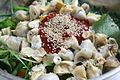
Preparing golbaengi-muchim

Golbaengi-muchim served with somyeon

See also
- Bún ốc
- Escargot
- List of salads
- Luósīfěn
References
^ National Institute of Korean Language (30 July 2014). "주요 한식명(200개) 로마자 표기 및 번역(영, 중, 일) 표준안" (PDF) (in Korean). Lay summary – National Institute of Korean Language..mw-parser-output cite.citationfont-style:inherit.mw-parser-output qquotes:"""""""'""'".mw-parser-output code.cs1-codecolor:inherit;background:inherit;border:inherit;padding:inherit.mw-parser-output .cs1-lock-free abackground:url("//upload.wikimedia.org/wikipedia/commons/thumb/6/65/Lock-green.svg/9px-Lock-green.svg.png")no-repeat;background-position:right .1em center.mw-parser-output .cs1-lock-limited a,.mw-parser-output .cs1-lock-registration abackground:url("//upload.wikimedia.org/wikipedia/commons/thumb/d/d6/Lock-gray-alt-2.svg/9px-Lock-gray-alt-2.svg.png")no-repeat;background-position:right .1em center.mw-parser-output .cs1-lock-subscription abackground:url("//upload.wikimedia.org/wikipedia/commons/thumb/a/aa/Lock-red-alt-2.svg/9px-Lock-red-alt-2.svg.png")no-repeat;background-position:right .1em center.mw-parser-output .cs1-subscription,.mw-parser-output .cs1-registrationcolor:#555.mw-parser-output .cs1-subscription span,.mw-parser-output .cs1-registration spanborder-bottom:1px dotted;cursor:help.mw-parser-output .cs1-hidden-errordisplay:none;font-size:100%.mw-parser-output .cs1-visible-errorfont-size:100%.mw-parser-output .cs1-subscription,.mw-parser-output .cs1-registration,.mw-parser-output .cs1-formatfont-size:95%.mw-parser-output .cs1-kern-left,.mw-parser-output .cs1-kern-wl-leftpadding-left:0.2em.mw-parser-output .cs1-kern-right,.mw-parser-output .cs1-kern-wl-rightpadding-right:0.2em
^ Zapana, Victor (26 November 2012). "Shaken". The New Yorker. Retrieved 8 May 2017.
^ Montgomery, Charles (26 October 2016). "Why Pojangmacha Street Food Is What You Need". 10 Magazine. Retrieved 8 May 2017.
^ ab "kolbaengi-much'im" 골뱅이무침. Chosŏn ryori (in Korean). Korean Association of Cooks. Retrieved 5 May 2017.
^ abcd "golbaengi-muchim" 골뱅이무침 [Spicy Sea Snails]. Doopedia (in Korean). Doosan Corporation. Retrieved 8 May 2017.
 | This Korean cuisine-related article is a stub. You can help Wikipedia by expanding it. |


