Delay differential equation
| Differential equations | ||||||
|---|---|---|---|---|---|---|
 Navier–Stokes differential equations used to simulate airflow around an obstruction. | ||||||
| ||||||
Classification | ||||||
Types
| ||||||
Relation to processes
| ||||||
Solution | ||||||
General topics
| ||||||
Solution methods
| ||||||
| ||||||
In mathematics, delay differential equations (DDEs) are a type of differential equation in which the derivative of the unknown function at a certain time is given in terms of the values of the function at previous times.
DDEs are also called time-delay systems, systems with aftereffect or dead-time, hereditary systems, equations with deviating argument, or differential-difference equations. They belong to the class of systems with the functional state, i.e. partial differential equations (PDEs) which are infinite dimensional, as opposed to ordinary differential equations (ODEs) having a finite dimensional state vector. Four points may give a possible explanation of the popularity of DDEs.[1] (1) Aftereffect is an applied problem: it is well known that, together with the increasing expectations of dynamic performances, engineers need their models to behave more like the real process. Many processes include aftereffect phenomena in their inner dynamics. In addition, actuators, sensors, communication networks that are now involved in feedback control loops introduce such delays. Finally, besides actual delays, time lags are frequently used to simplify very high order models. Then, the interest for DDEs keeps on growing in all scientific areas and, especially, in control engineering. (2) Delay systems are still resistant to many classical controllers: one could think that the simplest approach would consist in replacing them by some finite-dimensional approximations. Unfortunately, ignoring effects which are adequately represented by DDEs is not a general alternative: in the best situation (constant and known delays), it leads to the same degree of complexity in the control design. In worst cases (time-varying delays, for instance), it is potentially disastrous in terms of stability and oscillations. (3) Delay properties are also surprising since several studies have shown that voluntary introduction of delays can also benefit the control. (4) In spite of their complexity, DDEs however often appear as simple infinite-dimensional models in the very complex area of partial differential equations (PDEs).
A general form of the time-delay differential equation for x(t)∈Rndisplaystyle x(t)in mathbb R ^n
- ddtx(t)=f(t,x(t),xt),displaystyle frac rm drm dtx(t)=f(t,x(t),x_t),
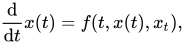
where xt=x(τ):τ≤tdisplaystyle x_t=x(tau ):tau leq t

R×Rn×C1(R,Rn)displaystyle mathbb R times mathbb R ^ntimes C^1(mathbb R ,mathbb R ^n)

Contents
1 Examples
2 Solving DDEs
2.1 Example
3 Reduction to ODE
4 The characteristic equation
5 Software
6 See also
7 Notes
8 References
9 External links
Examples
- Continuous delay
- ddtx(t)=f(t,x(t),∫−∞0x(t+τ)dμ(τ))displaystyle frac rm drm dtx(t)=fleft(t,x(t),int _-infty ^0x(t+tau ),rm dmu (tau )right)
- ddtx(t)=f(t,x(t),∫−∞0x(t+τ)dμ(τ))displaystyle frac rm drm dtx(t)=fleft(t,x(t),int _-infty ^0x(t+tau ),rm dmu (tau )right)

- Discrete delay
ddtx(t)=f(t,x(t),x(t−τ1),…,x(t−τm))displaystyle frac rm drm dtx(t)=f(t,x(t),x(t-tau _1),dotsc ,x(t-tau _m))for τ1>⋯>τm≥0displaystyle tau _1>dotsb >tau _mgeq 0
.
- Linear with discrete delays
- ddtx(t)=A0x(t)+A1x(t−τ1)+⋯+Amx(t−τm)displaystyle frac rm drm dtx(t)=A_0x(t)+A_1x(t-tau _1)+dotsb +A_mx(t-tau _m)
- ddtx(t)=A0x(t)+A1x(t−τ1)+⋯+Amx(t−τm)displaystyle frac rm drm dtx(t)=A_0x(t)+A_1x(t-tau _1)+dotsb +A_mx(t-tau _m)
- where A0,…,Am∈Rn×ndisplaystyle A_0,dotsc ,A_min mathbb R ^ntimes n
.

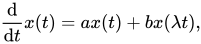
- Pantograph equation
- ddtx(t)=ax(t)+bx(λt),displaystyle frac rm drm dtx(t)=ax(t)+bx(lambda t),
- ddtx(t)=ax(t)+bx(λt),displaystyle frac rm drm dtx(t)=ax(t)+bx(lambda t),
- where a, b and λ are constants and 0 < λ < 1. This equation and some more general forms are named after the pantographs on trains.[2][3]
Solving DDEs
DDEs are mostly solved in a stepwise fashion with a principle called the method of steps. For instance, consider the DDE with a single delay
- ddtx(t)=f(x(t),x(t−τ))displaystyle frac rm drm dtx(t)=f(x(t),x(t-tau ))
- ddtx(t)=f(x(t),x(t−τ))displaystyle frac rm drm dtx(t)=f(x(t),x(t-tau ))
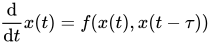
with given initial condition ϕ:[−τ,0]→Rndisplaystyle phi colon [-tau ,0]rightarrow mathbb R ^n![phi colon [-tau ,0]rightarrow mathbb R^n](https://wikimedia.org/api/rest_v1/media/math/render/svg/f4a1774f5874352a13dca8375241af7d1fdf489a)
![[0,tau ]](https://wikimedia.org/api/rest_v1/media/math/render/svg/b14403d0eabd32b34e2e6f594c91c4053ceb6363)

ddtψ(t)=f(ψ(t),ϕ(t−τ))displaystyle frac rm drm dtpsi (t)=f(psi (t),phi (t-tau )),
with ψ(0)=ϕ(0)displaystyle psi (0)=phi (0)
Example
Suppose f(x(t),x(t−τ))=ax(t−τ)displaystyle f(x(t),x(t-tau ))=ax(t-tau )

- x(t)=x(0)+∫s=0tddtx(s)ds=1+a∫s=0tϕ(s−τ)ds,displaystyle x(t)=x(0)+int _s=0^tfrac rm drm dtx(s),rm ds=1+aint _s=0^tphi (s-tau ),rm ds,

i.e., x(t)=at+1displaystyle x(t)=at+1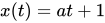

t∈[τ,2τ]displaystyle tin [tau ,2tau ]![tin [tau ,2tau ]](https://wikimedia.org/api/rest_v1/media/math/render/svg/c7451d2c3a0ff12aed45760865f2d43cb328ceee)
- x(t)=x(τ)+∫s=τtddtx(s)ds=(aτ+1)+a∫s=τta(s−τ)+1ds=(aτ+1)+a∫s=0t−τas+1ds,displaystyle beginalignedx(t)=x(tau )&+int _s=tau ^tfrac rm drm dtx(s),rm ds=(atau +1)\&+aint _s=tau ^ta(s-tau )+1,rm ds=(atau +1)+aint _s=0^t-tau as+1,rm ds,endaligned

i.e., x(t)=(aτ+1)+a(t−τ)(a(t−τ)2+1).displaystyle x(t)=(atau +1)+a(t-tau )left(frac a(t-tau )2+1right).

Reduction to ODE
In some cases, differential equation can be represented in a format that looks like a delay differential equations.
Example 1 Consider an equation
- ddtx(t)=f(t,x(t),∫−∞0x(t+τ)eλτdτ).displaystyle frac rm drm dtx(t)=fleft(t,x(t),int _-infty ^0x(t+tau )e^lambda tau ,rm dtau right).
- ddtx(t)=f(t,x(t),∫−∞0x(t+τ)eλτdτ).displaystyle frac rm drm dtx(t)=fleft(t,x(t),int _-infty ^0x(t+tau )e^lambda tau ,rm dtau right).

- Introduce y(t)=∫−∞0x(t+τ)eλτdτdisplaystyle y(t)=int _-infty ^0x(t+tau )e^lambda tau ,rm dtau
to get a system of ODEs
- ddtx(t)=f(t,x,y),ddty(t)=x−λy.displaystyle frac rm drm dtx(t)=f(t,x,y),quad frac rm drm dty(t)=x-lambda y.
- ddtx(t)=f(t,x,y),ddty(t)=x−λy.displaystyle frac rm drm dtx(t)=f(t,x,y),quad frac rm drm dty(t)=x-lambda y.

Example 2 An equation
- ddtx(t)=f(t,x(t),∫−∞0x(t+τ)cos(ατ+β)dτ)displaystyle frac rm drm dtx(t)=fleft(t,x(t),int _-infty ^0x(t+tau )cos(alpha tau +beta ),rm dtau right)
- ddtx(t)=f(t,x(t),∫−∞0x(t+τ)cos(ατ+β)dτ)displaystyle frac rm drm dtx(t)=fleft(t,x(t),int _-infty ^0x(t+tau )cos(alpha tau +beta ),rm dtau right)

- is equivalent to
- ddtx(t)=f(t,x,y),ddty(t)=cos(β)x+αz,ddtz(t)=sin(β)x−αy,displaystyle frac rm drm dtx(t)=f(t,x,y),quad frac rm drm dty(t)=cos(beta )x+alpha z,quad frac rm drm dtz(t)=sin(beta )x-alpha y,
- ddtx(t)=f(t,x,y),ddty(t)=cos(β)x+αz,ddtz(t)=sin(β)x−αy,displaystyle frac rm drm dtx(t)=f(t,x,y),quad frac rm drm dty(t)=cos(beta )x+alpha z,quad frac rm drm dtz(t)=sin(beta )x-alpha y,

- where
- y=∫−∞0x(t+τ)cos(ατ+β)dτ,z=∫−∞0x(t+τ)sin(ατ+β)dτ.displaystyle y=int _-infty ^0x(t+tau )cos(alpha tau +beta ),rm dtau ,quad z=int _-infty ^0x(t+tau )sin(alpha tau +beta ),rm dtau .
- y=∫−∞0x(t+τ)cos(ατ+β)dτ,z=∫−∞0x(t+τ)sin(ατ+β)dτ.displaystyle y=int _-infty ^0x(t+tau )cos(alpha tau +beta ),rm dtau ,quad z=int _-infty ^0x(t+tau )sin(alpha tau +beta ),rm dtau .

The characteristic equation
Similar to ODEs, many properties of linear DDEs can be characterized and analyzed using the characteristic equation.[4]
The characteristic equation associated with the linear DDE with discrete delays
- ddtx(t)=A0x(t)+A1x(t−τ1)+⋯+Amx(t−τm)displaystyle frac rm drm dtx(t)=A_0x(t)+A_1x(t-tau _1)+dotsb +A_mx(t-tau _m)
- ddtx(t)=A0x(t)+A1x(t−τ1)+⋯+Amx(t−τm)displaystyle frac rm drm dtx(t)=A_0x(t)+A_1x(t-tau _1)+dotsb +A_mx(t-tau _m)
is
det(−λI+A0+A1e−τ1λ+⋯+Ame−τmλ)=0displaystyle rm det(-lambda I+A_0+A_1e^-tau _1lambda +dotsb +A_me^-tau _mlambda )=0.
The roots λ of the characteristic equation are called characteristic roots or eigenvalues and the solution set is often referred to as the spectrum. Because of the exponential in the characteristic equation, the DDE has, unlike the ODE case, an infinite number of eigenvalues, making a spectral analysis more involved. The spectrum does however have some properties which can be exploited in the analysis. For instance, even though there are an infinite number of eigenvalues, there are only a finite number of eigenvalues to the right of any vertical line in the complex plane.[citation needed]
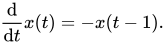
This characteristic equation is a nonlinear eigenproblem and there are many methods to compute the spectrum numerically.[5] In some special situations it is possible to solve the characteristic equation explicitly. Consider, for example, the following DDE:
- ddtx(t)=−x(t−1).displaystyle frac rm drm dtx(t)=-x(t-1).
The characteristic equation is
- −λ−e−λ=0.displaystyle -lambda -e^-lambda =0.,

There are an infinite number of solutions to this equation for complex λ. They are given by
λ=Wk(−1)displaystyle lambda =W_k(-1),
where Wk is the kth branch of the Lambert W function.
Software
In MATLAB, the function dde23 can be used to numerically solve delay differential equations.[6]
See also
- Functional differential equation
Notes
^ Richard, Jean-Pierre (2003). "Time Delay Systems: An overview of some recent advances and open problems". Automatica. 39 (10): 1667–1694. doi:10.1016/S0005-1098(03)00167-5..mw-parser-output cite.citationfont-style:inherit.mw-parser-output .citation qquotes:"""""""'""'".mw-parser-output .citation .cs1-lock-free abackground:url("//upload.wikimedia.org/wikipedia/commons/thumb/6/65/Lock-green.svg/9px-Lock-green.svg.png")no-repeat;background-position:right .1em center.mw-parser-output .citation .cs1-lock-limited a,.mw-parser-output .citation .cs1-lock-registration abackground:url("//upload.wikimedia.org/wikipedia/commons/thumb/d/d6/Lock-gray-alt-2.svg/9px-Lock-gray-alt-2.svg.png")no-repeat;background-position:right .1em center.mw-parser-output .citation .cs1-lock-subscription abackground:url("//upload.wikimedia.org/wikipedia/commons/thumb/a/aa/Lock-red-alt-2.svg/9px-Lock-red-alt-2.svg.png")no-repeat;background-position:right .1em center.mw-parser-output .cs1-subscription,.mw-parser-output .cs1-registrationcolor:#555.mw-parser-output .cs1-subscription span,.mw-parser-output .cs1-registration spanborder-bottom:1px dotted;cursor:help.mw-parser-output .cs1-ws-icon abackground:url("//upload.wikimedia.org/wikipedia/commons/thumb/4/4c/Wikisource-logo.svg/12px-Wikisource-logo.svg.png")no-repeat;background-position:right .1em center.mw-parser-output code.cs1-codecolor:inherit;background:inherit;border:inherit;padding:inherit.mw-parser-output .cs1-hidden-errordisplay:none;font-size:100%.mw-parser-output .cs1-visible-errorfont-size:100%.mw-parser-output .cs1-maintdisplay:none;color:#33aa33;margin-left:0.3em.mw-parser-output .cs1-subscription,.mw-parser-output .cs1-registration,.mw-parser-output .cs1-formatfont-size:95%.mw-parser-output .cs1-kern-left,.mw-parser-output .cs1-kern-wl-leftpadding-left:0.2em.mw-parser-output .cs1-kern-right,.mw-parser-output .cs1-kern-wl-rightpadding-right:0.2em
^ Griebel, Thomas (2017-01-01). "The pantograph equation in quantum calculus". Masters Theses.
^ "The dynamics of a current collection system for an electric locomotive". royalsocietypublishing.org. 1971. doi:10.1098/rspa.1971.0078. Retrieved 2019-01-26.
^ Michiels, Niculescu, 2007 Chapter 1
^ Michiels, Niculescu, 2007 Chapter 2
^ Shampine, L. F.; Thompson, S. (2001). "Solving DDEs in Matlab" (PDF). Applied Numerical Mathematics. 37 (4): 441. doi:10.1016/S0168-9274(00)00055-6. Archived from the original (PDF) on 2016-03-03.
References
.mw-parser-output .refbeginfont-size:90%;margin-bottom:0.5em.mw-parser-output .refbegin-hanging-indents>ullist-style-type:none;margin-left:0.mw-parser-output .refbegin-hanging-indents>ul>li,.mw-parser-output .refbegin-hanging-indents>dl>ddmargin-left:0;padding-left:3.2em;text-indent:-3.2em;list-style:none.mw-parser-output .refbegin-100font-size:100%
Bellman, Richard; Cooke, Kenneth L. (1963). Differential-difference equations. New York-London: Academic Press. ISBN 978-0-12-084850-8.
Driver, Rodney D. (1977). Ordinary and Delay Differential Equations. New York: Springer Verlag. ISBN 0-387-90231-7.
Michiels, Wim; Niculescu, Silviu-Iulian (2007). Stability and stabilization of time-delay systems. An eigenvalue based approach. doi:10.1137/1.9780898718645. ISBN 978-0-89871-632-0.
Briat, Corentin (2015). Linear Parameter-Varying and Time-Delay Systems. Analysis, Observation, Filtering & Control. Springer Verlag Heidelberg. ISBN 978-3-662-44049-0.
External links
Skip Thompson (ed.). "Delay-Differential Equations". Scholarpedia.


